
If you are shopping for a 1.5 Ton inverter air conditioner in India, you have almost certainly hit the ₹8,000 dilemma: a reputable 1.5 Ton 3-Star Inverter AC sells between ₹32,000 and ₹36,000, while an equivalent 5-Star Inverter AC from the same brand demands ₹41,000 to ₹46,000. Retail sales representatives frequently insist that the 5-Star machine will "pay for itself in electricity savings within a year," yet they almost never show you the transparent mathematical calculations based on your specific state's tiered electricity tariff slabs.
⚡ The Quick Answer (Monthly Bill & Payback Snapshot)
Running a modern 1.5 Ton Inverter AC for 8 hours every night at an average Indian urban tariff of ₹8.00 per unit (kWh):
- 1.5 Ton 3-Star Inverter AC (ISEER ~3.9): Consumes ~9.5 to 10.2 units per day = ~₹2,280 to ₹2,450 per month.
- 1.5 Ton 5-Star Inverter AC (ISEER ~5.2): Consumes ~6.8 to 7.4 units per day = ~₹1,630 to ₹1,780 per month.
- Net Monthly Cash Savings: ₹600 to ₹700 per month during peak summer cooling.
- Break-Even Payback Window: If you run your AC heavily for 5 to 6 months annually, the ₹8,000 price gap is recovered in approximately 2.3 to 2.8 summer seasons. Beyond year three, the 5-Star machine yields pure financial profit.
However, real Indian households do not live inside laboratory testing chambers. Real-world power bills depend heavily on ambient outdoor temperatures (a blistering 45°C in Delhi, Ahmedabad, or Nagpur forces compressors to run at maximum wattage far longer than a humid 33°C in Mumbai or Chennai), roof insulation, top-floor solar heat radiation, room volume, and tiered DISCOM tariff structures where crossing 400 or 500 monthly units doubles your per-unit billing rate.
Below is the complete, mathematically grounded engineering guide to calculating your exact AC electricity bill, decoding Bureau of Energy Efficiency (BEE) ISEER ratings, and determining whether a 3-Star or 5-Star machine makes genuine financial sense for your specific home.
1. The Hidden Cost of Summer: Why Upfront AC Price is Only Half the Story
An air conditioner is fundamentally unlike almost any other household appliance. A television, front-load washing machine, or frost-free refrigerator draws relatively modest or steady electrical loads. An air conditioner, by contrast, operates on high-pressure thermodynamic vapor-compression refrigeration. Over a typical 7- to 8-year ownership cycle, the electricity consumed by a 1.5 Ton air conditioner will cost between ₹95,000 and ₹1,65,000—more than triple its original showroom purchase invoice.
To understand why energy efficiency ratings create such massive cumulative rupee differences, we must first dispel the confusion between obsolete fixed-speed compressors and modern variable-speed inverter technology.
Fixed-Speed vs Inverter Compressors: The Thermodynamic Power Curve
In older non-inverter (fixed-speed) air conditioners, the compressor motor operates in a binary state: it is either 100% ON or 100% OFF. When you configure the temperature to 24°C, a 1.5 Ton fixed-speed compressor draws its full rated wattage (~1,500W to 1,850W) continuously until the room reaches 23.5°C, shuts off abruptly with a mechanical thud, waits until natural room heat infiltration warms the air back up to 25°C, and then restarts with a massive inrush electrical surge. This perpetual on-off cycle wastes immense electricity and produces noticeable, uncomfortable room temperature fluctuations.
Modern Inverter ACs utilize variable-speed BLDC (Brushless DC) compressors driven by intelligent microcontrollers. When initially switched on in a hot room, the compressor ramps up to maximum frequency to extract heat rapidly. Once the target setpoint is achieved, rather than shutting off, the inverter throttles the motor down to 35%, 25%, or even 15% of its rated capacity. At steady-state cruising during a cool night, a high-efficiency inverter AC can draw as little as 280W to 420W—less than four ceiling fans—maintaining an exact, stable temperature without inductive surges.
Inverter ACs deliver maximum energy savings when operating at partial load. If your room is undersized, has unshaded western-facing glass windows, or sits directly under an uninsulated terrace roof during peak North Indian summer, the compressor may remain pinned at 100% maximum speed for hours. In such extreme heat-load environments, even a 5-Star AC can draw 1,350W continuously until ambient outdoor temperatures decline after midnight.
Decoding ISEER: The Real-World Efficiency Metric
Prior to 2018, Indian air conditioners were rated using simple EER (Energy Efficiency Ratio), which measured cooling performance at a single arbitrary outdoor test temperature (35°C). Because outdoor temperatures across India fluctuate between 20°C and 48°C across changing seasons, the Bureau of Energy Efficiency (BEE) introduced ISEER (Indian Seasonal Energy Efficiency Ratio).
ISEER calculates the ratio of the total annual amount of heat the AC can remove from indoor air to the total annual amount of energy it consumes, weighted across Indian climatic temperature bins from 24°C to 43°C.
| BEE Star Rating | ISEER Efficiency Range | Avg. Steady-State Power Draw (1.5 Ton) | Annual Energy on BEE Label* |
|---|---|---|---|
| 3-Star Inverter | 3.80 to 4.39 | ~1,100W – 1,300W (Blended avg: ~1.20 kW) | ~950 to 1,050 kWh / year |
| 4-Star Inverter | 4.40 to 4.99 | ~950W – 1,100W (Blended avg: ~1.05 kW) | ~830 to 920 kWh / year |
| 5-Star Inverter | 5.00 to 5.80+ | ~750W – 950W (Blended avg: ~0.88 kW) | ~650 to 780 kWh / year |
2. Step-by-Step Electricity Bill Calculation Formula for Indian Households
Calculating your monthly air conditioning running expense does not require specialized electrical engineering knowledge. You can determine your exact figures using a three-step formula:
The Core Mathematical Formula
-
Calculate Daily Units Consumed (kWh):
Daily Units = Average Power Draw (in kW) × Number of Operating Hours Per Day
(Note: 1,000 Watts = 1.0 Kilowatt. For an inverter AC drawing an average of 900 Watts, the input is 0.90 kW). -
Calculate Monthly Units Consumed:
Monthly Units = Daily Units × 30 Days -
Calculate Total Monthly Rupee Cost:
Total Monthly AC Bill (₹) = Monthly Units × Electricity Tariff Rate per Unit (₹/kWh)
Indian State Power Tariff Slabs: The Hidden Multiplier
The most common mistake consumers make when calculating power bills is using their utility's entry-level tariff slab (e.g., ₹4.50/unit for the first 100 units). In India, power utilities (DISCOMs) use telescopic slab billing. Your baseline lighting, fans, refrigerator, and entertainment gadgets already exhaust your cheaper initial tiers.
The heavy inductive load added by an air conditioner lands directly in your highest marginal tariff slab.
| State / Metro Discom | Typical High-Consumption Slab (>300–500 Units) | Fixed Surcharges & Taxes | Realistic Blended AC Tariff (₹/Unit) |
|---|---|---|---|
| Delhi (BSES Rajdhani / Yamuna / TPDDL) | ₹6.50 – ₹8.00 / unit (>400 units) | Power Purchase Adjustment (PPAC ~20–30%) + Surcharges | ₹8.00 – ₹9.00 |
| Maharashtra (MSEDCL / Adani Mumbai) | ₹10.50 – ₹13.80 / unit (>300–500 units) | Wheeling Charges + Fuel Adjustment (FAC) | ₹11.00 – ₹13.50 |
| Karnataka (BESCOM Bengaluru) | ₹7.00 – ₹8.50 / unit | Fuel Cost Adjustment (FAC) + Fixed Load Levies | ₹8.00 – ₹9.50 |
| Uttar Pradesh (UPPCL Urban) | ₹6.50 – ₹7.50 / unit (>500 units) | Electricity Duty (5%) + Regulatory Levies | ₹7.50 – ₹8.50 |
| Tamil Nadu (TANGEDCO) | ₹6.00 – ₹8.00 / unit (>500 units bi-monthly) | Fixed Bimonthly Grid Charges | ₹7.00 – ₹8.00 |
| West Bengal (CESC Kolkata) | ₹7.50 – ₹9.20 / unit (>300 units) | Monthly Variable Fuel Surcharges | ₹8.50 – ₹9.80 |
For the scenario comparisons below, we utilize a balanced Indian urban baseline rate of ₹8.00 per unit, while demonstrating how higher tariffs (such as Mumbai's ₹12.00/unit) accelerate return on investment.
3. Head-to-Head: 1.5 Ton 3-Star vs 5-Star Inverter AC Running Costs
Let us evaluate three authentic household operating scenarios. In each case, we compare a modern 1.5 Ton 3-Star Inverter AC (average steady-state draw of ~1.20 kW) against a top-tier 1.5 Ton 5-Star Inverter AC (average steady-state draw of ~0.90 kW).
Scenario A: Moderate Bedroom Usage (6 Hours / Night)
Typical profile: Working professionals who power on the AC around 11:00 PM and use a sleep off-timer, or cool down the room before sleeping.
- 3-Star Inverter AC: 1.20 kW × 6 hrs = 7.2 units/day × 30 days = 216 units/month.
Monthly Bill (@ ₹8/unit):216 × ₹8.00= ₹1,728. - 5-Star Inverter AC: 0.90 kW × 6 hrs = 5.4 units/day × 30 days = 162 units/month.
Monthly Bill (@ ₹8/unit):162 × ₹8.00= ₹1,296. - Monthly Difference: 54 units saved = ₹432 saved per month.
Scenario B: Heavy Daily Usage (10 Hours / Day)
Typical profile: Master bedrooms running through the night (10:00 PM to 7:00 AM) plus an afternoon rest, or dedicated home offices during remote work.
- 3-Star Inverter AC: 1.20 kW × 10 hrs = 12.0 units/day × 30 days = 360 units/month.
Monthly Bill (@ ₹8/unit):360 × ₹8.00= ₹2,880. - 5-Star Inverter AC: 0.90 kW × 10 hrs = 9.0 units/day × 30 days = 270 units/month.
Monthly Bill (@ ₹8/unit):270 × ₹8.00= ₹2,160. - Monthly Difference: 90 units saved = ₹720 saved per month.
Scenario C: Extreme Heatwave & Continuous Usage (14 Hours / Day)
Typical profile: Top-floor rooms, joint families with elders/children staying home all day during May–June, or living rooms with large glass windows.
- 3-Star Inverter AC: 1.20 kW × 14 hrs = 16.8 units/day × 30 days = 504 units/month.
Monthly Bill (@ ₹8/unit):504 × ₹8.00= ₹4,032. - 5-Star Inverter AC: 0.90 kW × 14 hrs = 12.6 units/day × 30 days = 378 units/month.
Monthly Bill (@ ₹8/unit):378 × ₹8.00= ₹3,024. - Monthly Difference: 126 units saved = ₹1,008 saved per month.
| Usage Pattern | Daily Hours | 3-Star Monthly Units (Bill @ ₹8) | 5-Star Monthly Units (Bill @ ₹8) | Monthly Cash Savings | Annual Savings (5-Month Summer) |
|---|---|---|---|---|---|
| Moderate | 6 hrs/day | 216 units (₹1,728) | 162 units (₹1,296) | ₹432 / mo | ₹2,160 / year |
| Heavy | 10 hrs/day | 360 units (₹2,880) | 270 units (₹2,160) | ₹720 / mo | ₹3,600 / year |
| Extreme | 14 hrs/day | 504 units (₹4,032) | 378 units (₹3,024) | ₹1,008 / mo | ₹5,040 / year |
4. The Break-Even Analysis: Is a 5-Star AC Really Worth the Extra Money?
Now let us resolve the core financial puzzle: When does a 5-Star AC recover its purchase premium?
Across reputable manufacturers like Daikin, LG, Voltas, and Blue Star, the average showroom price gap between a 1.5 Ton 3-Star and 1.5 Ton 5-Star unit sits between ₹7,500 and ₹9,000 (we will utilize a standard ₹8,000 upfront premium).
In most Indian climatic zones, cooling is required heavily for about 5 months (April through August), followed by intermittent monsoon dehumidification.
| Daily Usage & Electricity Tariff | Annual Summer Savings (5 Months) | Break-Even Payback Period | 5-Year Cumulative Savings (After Paying Upfront Premium) |
|---|---|---|---|
| 6 Hours / Day (@ ₹8 / Unit) | ₹2,160 / year | 3.7 Years | +₹2,800 net profit |
| 10 Hours / Day (@ ₹8 / Unit) | ₹3,600 / year | 2.2 Years | +₹10,000 net profit |
| 10 Hours / Day (@ ₹11 / Unit - Mumbai) | ₹4,950 / year | 1.6 Years | +₹16,750 net profit |
| 14 Hours / Day (@ ₹8 / Unit) | ₹5,040 / year | 1.6 Years | +₹17,200 net profit |
The 5-Year Total Cost of Ownership (TCO)
Over 5 years of regular, heavy ownership (10 hours daily, 5 months/year at ₹8/unit):
- 1.5 Ton 3-Star AC: Upfront Price ₹34,000 + Electricity ₹72,000 = Total ₹1,06,000.
- 1.5 Ton 5-Star AC: Upfront Price ₹42,000 + Electricity ₹54,000 = Total ₹96,000.
Even after spending an additional ₹8,000 on day one, the 5-Star machine owner is ₹10,000 richer by year five. In higher-tariff metropolitan markets such as Mumbai, Pune, or Bengaluru, the net cumulative saving surpasses ₹16,000.
5. Room Sizing & Heat Load Physics: Why Undersizing Destroys Efficiency
A critical error Indian apartment buyers frequently make is purchasing a 1.0 Ton or 3-Star AC for a large room to save money, unaware that an undersized air conditioner consumes more electricity than a properly sized 1.5 Ton unit.
The Physics of Heat Infiltration in Indian Architecture
Air conditioning capacity is measured in British Thermal Units (BTU). A 1.5 Ton AC provides approximately 18,000 BTU/hr of cooling capacity (5,275 Watts). When an AC is undersized for a room:
- Zero Inverter Throttling: The compressor never cools the space down to the setpoint, forcing the motor to run at 100% maximum wattage indefinitely. An undersized 1.0 Ton AC running continuously at full load (~1,100W) draws more total daily energy than a 1.5 Ton 5-Star unit that pulls the room down quickly and throttles down to 350W.
- Terrace Slab Solar Radiance: In top-floor flats, concrete roof slabs absorb direct solar radiation throughout the day, re-radiating heat into the room well into the night. Top-floor rooms require at least 0.5 Ton additional cooling capacity to compensate for structural thermal mass.
- Window Glass Exposure: Unshaded single-pane glass windows facing West or South add roughly 40 to 60 Watts of heat gain per square foot of glass during afternoon hours.
| Room Floor Area | Standard Middle Floor (Normal Heat Load) | Top Floor / Western Sun Exposure (High Heat Load) | Recommended Inverter Tonnage |
|---|---|---|---|
| Up to 110 sq. ft. | Light bedroom / study | Direct roof sun exposure | 1.0 Ton Inverter |
| 111 to 150 sq. ft. | Standard master bedroom | Top-floor master bedroom | 1.5 Ton (3-Star or 5-Star) |
| 151 to 200 sq. ft. | Large master bedroom | West-facing master bedroom | 1.5 Ton 5-Star (High CFM Airflow) |
| 201 to 260 sq. ft. | Living room / dining hall | Top-floor open living hall | 2.0 Ton Inverter |
6. Real-World Efficiency Shootout: Popular 1.5 Ton Models on PriceHunt
To anchor these calculations in machines you can actually buy right now in India, let us review verified models actively cataloged and price-tracked in the PriceHunt Air Conditioners catalog:
1. Daikin 1.5 Ton 3-Star Inverter Split AC (ATKL50TV Series)
Daikin's 1.5 Ton 3-Star Inverter AC is one of India's most widely installed bedroom split units. It delivers an ISEER rating of approximately 3.95 and incorporates Daikin’s proprietary Neo Swing compressor, which substantially reduces internal friction and refrigerant leakage.
Why It Wins
- Proven 100% copper condenser tubing with anti-corrosive fin treatment.
- Smooth low-frequency partial-load throttling down to ~350W once the room reaches setpoint.
- Competitive market price (~₹36,000–₹38,000).
Keep in Mind
- Annual unit consumption (~960 kWh) is roughly 250 units higher than Daikin's 5-Star series.
- Basic display panel without integrated smart Wi-Fi on entry variants.
2. LG 1.5 Ton 5-Star Split AI Dual Inverter AC
LG's 1.5 Ton 5-Star AI Dual Inverter AC sits in the top tier of energy conservation with an impressive ISEER score exceeding 5.20. It utilizes dual-rotary compression to dampen mechanical vibration while enabling ultra-fast initial pull-down cooling.
Why It Wins
- Exceptional energy conservation; throttles as low as 280W in 40% AI Convertible mode.
- Ocean Black Fin coating guards against salt air corrosion in coastal cities like Mumbai and Chennai.
- Recovers its price premium in under 2.5 years with 8+ hours of daily summer use.
Keep in Mind
- Higher initial purchase cost (~₹44,000–₹47,000).
- Out-of-warranty inverter PCB replacements can be costly (extended warranty recommended).
3. Voltas 1.5 Ton 3-Star Inverter Split AC (183V Vectra Series)
Voltas 1.5 Ton 183V Vectra is engineered specifically for punishing North Indian heatwaves, maintaining cooling output at ambient temperatures up to 52°C.
Why It Wins
- Outstanding entry price-to-performance ratio (~₹31,000–₹34,000 during festive promotions).
- Expansive authorized service network across Tier 2, Tier 3, and suburban India.
- Wide-band stabilizer-free operation (110V to 285V).
Keep in Mind
- Base ISEER (~3.81) causes running costs to escalate quickly if operated beyond 10 hours daily.
- Slightly higher indoor blower acoustic levels on maximum turbo fan setting.
4. Blue Star 1.5 Ton 5-Star Inverter Split AC (IE518RNUR)
Blue Star's 5-Star Inverter AC is engineered for commercial-grade durability, pairing heavy-gauge copper coils with an acoustic compressor enclosure for near-silent operation.
Why It Wins
- Robust ISEER performance (5.0+) with rapid pull-down cooling capability.
- Heavy-duty outdoor chassis that resists rust and physical wear under prolonged heatwave stress.
Keep in Mind
- Premium showroom pricing; demands disciplined daily usage to maximize return on investment.
5. Carrier 1.5 Ton 3-Star Window AC
For rooms where split installation is architecturally restricted by housing society rules or rental agreements, the Carrier 1.5 Ton 3-Star Window AC offers dependable cooling without refrigerant line plumbing.
Why It Wins
- Zero wall drilling or copper piping installation expenses.
- Heavy-duty rotary compressor with reliable thermal overload protection.
Keep in Mind
- Window units have inherently lower ISEER ratings (~3.1 to ~3.3) compared to modern split inverters.
- Higher operational acoustic noise since the compressor sits directly inside the window frame.
Want to compare complete hardware specifications side by side? Use our Head-to-Head Comparison Matrix or monitor live festive discounts across Amazon and Flipkart on the PriceHunt Deals Tracker.
7. Five Practical Rules to Slash Your Monthly AC Bill by 25%
Regardless of whether you choose a 3-Star or 5-Star unit, daily operational habits dictate your actual meter readings. Apply these five proven techniques to keep your inverter compressor running at its most energy-efficient throttle state:
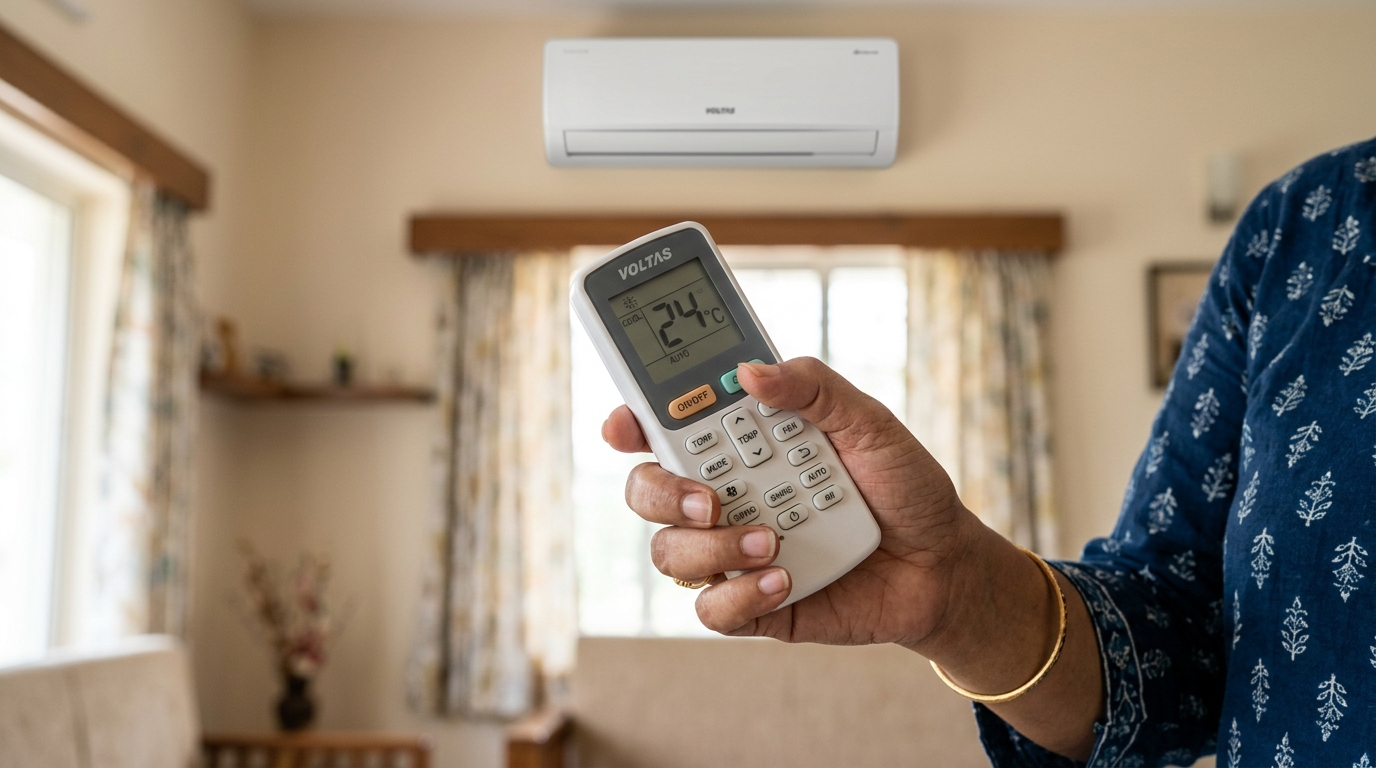
Rule 1: Set the Thermostat to 24°C–25°C (The Bureau of Energy Efficiency Standard)
Every single 1°C decrease below 24°C forces your compressor to consume approximately 6% more electricity. Cranking an AC down to 18°C does not cool a room faster—the compressor outputs the exact same BTUs of cooling whether configured to 18°C or 24°C. Setting it to 18°C simply ensures that the compressor never throttles down to its low-wattage cruising mode, burning peak power continuously.
Rule 2: Pair the AC with a Low-Speed Ceiling Fan
Cooling air and circulating air are distinct physical mechanisms. Operating your AC at 25°C while running a ceiling fan at low speed (speed 1 or 2) creates a gentle evaporative wind-chill across your skin. This makes a 25°C room feel like 22.5°C to your body, allowing you to enjoy complete comfort while saving roughly 15% on monthly power.
Rule 3: Clean Nylon Mesh Air Filters Every 15 Days
Indian urban centers have notoriously high particulate dust levels. When dust accumulates on the indoor nylon mesh filter, return airflow across the cooling coil drops by up to 30%. The compressor is forced to run longer cycles at higher wattages to compensate. Washing your mesh filters under running tap water takes 5 minutes and immediately restores thermodynamic airflow efficiency.
Rule 4: Seal Door Undercuts and Window Gaps
A standard 1-inch air gap beneath a bedroom door allows cool, dense air to spill into uncooled hallways while drawing warm air into the room. Installing an inexpensive ₹300 silicone bottom door strip prevents thermal leakage, helping your inverter compressor settle into idle speed up to 20 minutes faster.
Rule 5: Keep the Outdoor Unit (ODU) in the Shade
When your outdoor condenser unit bakes under direct midday sunlight on an open terrace, heat rejection through the condensing coil becomes thermally constrained, raising compressor head pressure and electrical draw. Installing a lightweight canopy or positioning the ODU in a shaded, well-ventilated balcony corner reduces condensing temperatures and cuts heatwave power consumption by 5% to 8%.
8. Frequently Asked Questions (BEE Ratings & Electricity Bills)
A: A modern 1.5 Ton 5-Star Inverter AC typically consumes between 6.5 and 7.5 units (kWh) over an 8-hour night at a 24°C setpoint. A 1.5 Ton 3-Star Inverter AC consumes between 9.0 and 10.5 units under identical ambient conditions. In older non-inverter fixed-speed models, consumption regularly exceeds 12.0 to 14.0 units.
A: No. If the air conditioner runs only 2 to 4 hours intermittently, or sits in a guest room used only a few weeks each year, the monthly electricity difference is under ₹200. You will not recover the ₹8,000 upfront premium within the practical lifespan of the appliance. A reliable 3-Star Inverter AC is the smarter financial choice.
A: Most modern inverter ACs include built-in stabilizer-free operation covering an input window from 140V to 285V. However, if your residential area experiences severe brownouts (voltage dropping below 130V) or sudden post-load-shedding surges (spiking above 290V), investing ₹2,500 in a dedicated 4kVA digital stabilizer with high-voltage cut-off protects the sensitive outdoor inverter PCB.
A: This occurs due to telescopic DISCOM slab rates. Adding 300 to 400 monthly units during summer pushes your household's total consumption into the highest pricing tier (e.g., from ₹5.50/unit to ₹8.50 or ₹12.00/unit in states like Maharashtra or Karnataka). This amplifies the rupee cost of every single unit consumed by all appliances across your home.
9. Final Buying Verdict: Which Star Rating Should You Choose?
-
Buy a 1.5 Ton 5-Star Inverter AC if:
- You run your AC for 8 to 12+ hours daily (e.g., your primary master bedroom or full-time home office).
- You reside in a high-tariff state or metro area (Maharashtra, Karnataka, or urban UP) where power costs ₹8.50 to ₹13.00 per unit.
- You intend to remain in your current home for 3 or more years, easily pocketing the ₹10,000–₹16,000 net 5-year profit.
-
Buy a 1.5 Ton 3-Star Inverter AC if:
- Your operational usage is strictly under 4 to 5 hours daily (e.g., guest rooms, dining halls, or night-only cooling in mild coastal climates).
- You have a rigid upfront budget limit capped around ₹30,000–₹35,000.
- You reside in a temporary rental flat where you may relocate within 1 to 2 cooling seasons.