




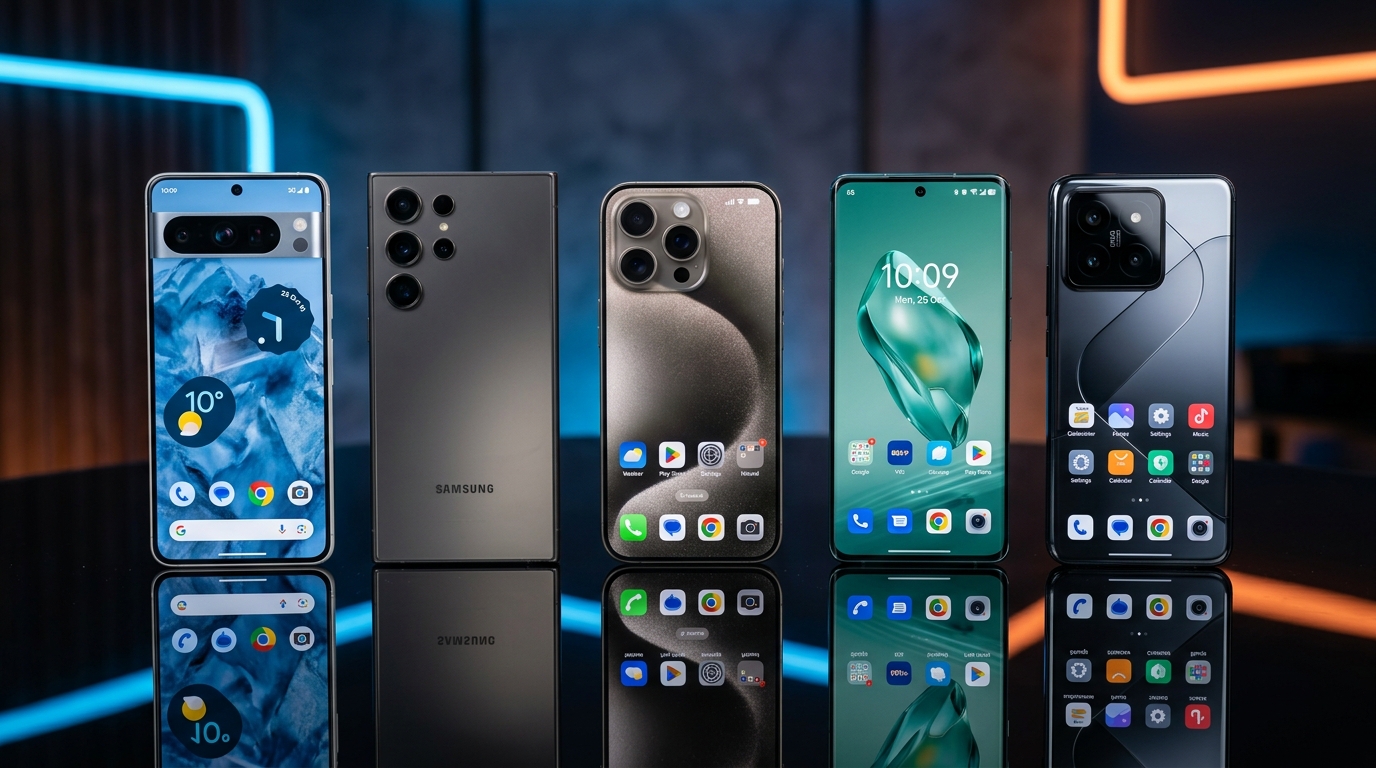
With India standing as the world's most competitive smartphone market and over 1,000 active devices available across price tiers, finding the perfect mobile phone requires cutting through deceptive megapixel marketing, synthetic processor benchmarks, and carrier 5G claims.
Our comprehensive Smartphone Buying Guide decodes essential Indian network requirements (Jio SA vs Airtel NSA 5G bands, NavIC satellite support), 3nm/4nm processor architectures, Sony LYT camera sensors with Optical Image Stabilization (OIS), high-capacity silicon-carbon batteries, and software update commitments ranging from budget champions to ultra-premium flagships.
Contents at a Glance
1. Indian 5G Bands, Network Architectures & NavIC Connectivity
A smartphone may advertise "5G connectivity", but if it lacks the specific radio frequencies deployed by Indian telecom operators, you will be stranded on sub-optimal speeds or fallback 4G LTE. India operates two fundamentally different 5G network architectures:
Standalone (SA) 5G Architecture
Relies entirely on dedicated 5G core infrastructure without 4G fallback anchors. Crucially depends on the N28 (700 MHz) sub-GHz band for deep indoor building penetration and rural signal coverage, combined with the N78 (3500 MHz) mid-band for high-bandwidth gigabit downlink speeds. Your smartphone must support both N28 and N78, as well as Voice over New Radio (VoNR) for high-definition calling directly over 5G without network switching drops.
Non-Standalone (NSA) 5G Architecture
Leverages existing 4G LTE anchor cores paired with 5G radio carriers, predominantly utilizing the N78 (3500 MHz) and N1 (2100 MHz) / N3 (1800 MHz) spectrum bands. Ensure any phone you purchase supports carrier aggregation (4G+ and 5G dual active) to prevent sudden battery drain when handing off between cell towers.
Mandatory 5G Bands Checklist for India:
- Absolute Minimum: At least 8 to 12 global 5G bands: N1, N3, N5, N8, N28, N40, N41, N77, N78. Never purchase a phone advertising fewer than 6 bands.
- NavIC (ISRO Satellite Navigation): Check that the chipset supports India's indigenous NavIC constellation (L5 frequency band) for sub-meter GPS accuracy in congested urban canyons and rural highways.
- Dual SIM 5G Dual Standby (DSDS): Both physical SIM slots (or eSIM profile) must support simultaneous 5G data and VoNR calling.
2. Mobile Processor Hierarchy: 2026 SoC Showdown
The System-on-Chip (SoC) governs system fluidness, camera image signal processing (ISP), on-device AI operations, thermal throttling, and battery endurance. Fabrication nodes (3nm vs 4nm vs 6nm) determine power efficiency:
| Performance Tier | Qualcomm Snapdragon | MediaTek Dimensity | Apple / Google | Target Usage & Gaming Experience |
|---|---|---|---|---|
| Ultra-Flagship (Tier 1) | Snapdragon 8 Elite / 8 Gen 3 | Dimensity 9400 / 9300+ | Apple A18 Pro / A17 Pro | Consistently 90–120 FPS in BGMI / Genshin Impact, 8K video recording, generative AI on-device |
| Upper Mid-Range / Flagship Killer (Tier 2) | Snapdragon 8s Gen 3 / 7+ Gen 3 | Dimensity 8300 Ultra / 8200 | Google Tensor G4 | Smooth 60–90 FPS heavy gaming, zero daily UI stutter, fast 4K 60fps image rendering |
| Mainstream Sweet Spot (Tier 3) | Snapdragon 6 Gen 1 / 4 Gen 2 | Dimensity 7200 / 7050 / 6300 | Apple A15 (Refurbished) | Ideal for students and daily work, social media, multitasking, casual 40–60 FPS gaming |
| Entry-Level Budget (Tier 4) | Snapdragon 4s Gen 2 | Dimensity 6100+ / Helio G99 | Unisoc T616 / T612 | Basic WhatsApp, UPI payments, YouTube streaming, calling (avoid for heavy gaming) |
3. Display Technology, Refresh Rates & Eye-Care PWM Dimming
Because you interact with your smartphone display dozens of times an hour, panel quality directly dictates eye strain and battery consumption:
AMOLED vs IPS LCD
Always prioritize AMOLED (Active Matrix Organic Light Emitting Diode) panels over traditional IPS LCDs. AMOLED features self-illuminating individual pixels, yielding infinite contrast ratios, pitch-perfect true blacks, and lower battery drain in Dark Mode. In 2026, even sub-₹15,000 devices offer vibrant 120Hz AMOLED screens.
120Hz LTPO Dynamic Refresh Rate
Standard displays refresh at 60Hz. A 120Hz panel doubles animation frames, making app scrolling, system gestures, and web browsing feel instantaneous. Premium flagships feature LTPO (Low-Temperature Polycrystalline Oxide) panels that dynamically scale from 120Hz down to 1Hz when viewing static text or Always-On displays, conserving up to 20% battery life.
Peak Brightness (High Brightness Mode - HBM)
Under the blinding afternoon Indian sun, displays with under 800 nits become unreadable mirrors. Look for phones specifying at least 1,200 to 1,600 nits HBM (High Brightness Mode) or 2,500+ nits peak brightness for clear outdoor navigation on Google Maps.
High-Frequency PWM Dimming (2160Hz / 3840Hz)
OLED screens regulate brightness by pulsing light on and off rapidly (Pulse-Width Modulation). Low-frequency PWM (below 480Hz) causes subconscious retinal strain, dry eyes, and headaches during nighttime bed reading. Choose devices advertising 2160Hz or 3840Hz ultra-high frequency PWM dimming or DC-like eye protection certifications.
4. Camera Hardware: Why Sensor Size & OIS Trump Megapixel Counts
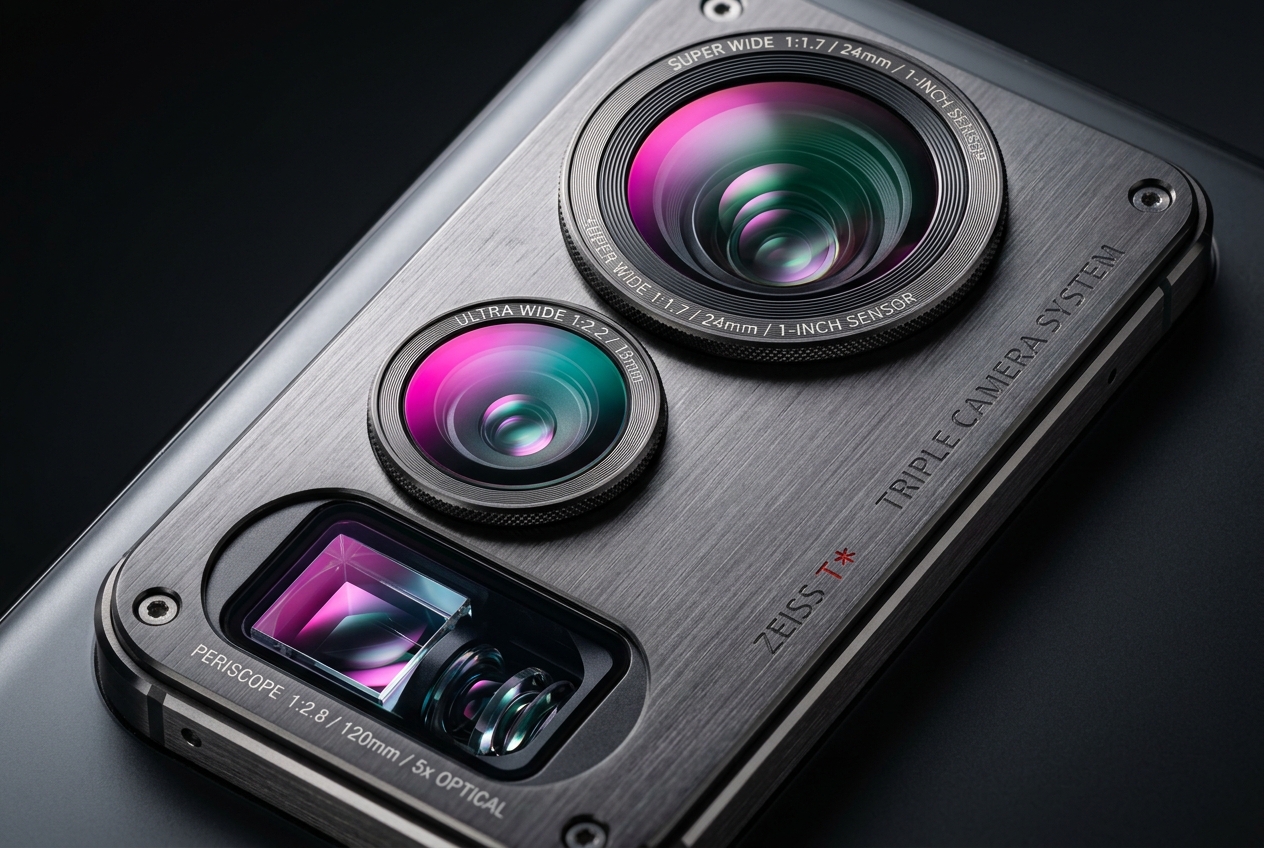
Do not be misled by inflated 108MP or 200MP marketing claims on budget phones. The physical dimensions of the camera sensor and the presence of Optical Image Stabilization (OIS) dictate photographic clarity far more than raw pixel quantity.
Sensor Dimensions (1-inch & 1/1.3-inch Sony LYT / Samsung ISOCELL)
A larger physical sensor (such as the Sony LYT-900 / IMX890 or Samsung HP2) captures exponentially more photons of light, producing natural shallow depth-of-field (bokeh) without artificial software blurring and dramatic reductions in low-light noise during Diwali night photography.
Optical Image Stabilization (OIS) is Non-Negotiable
OIS physically suspends the camera lens inside electromagnetic gyroscopic coils to counteract handshake tremors in real time. Without OIS, evening and night photos blur instantly, and indoor video recordings suffer from nauseating judder.
Periscope Telephoto vs 2MP Filler Cameras
Beware of cheap budget phones padding their camera count with useless 2MP macro and 2MP depth sensors. A true photography system offers a wide main camera, an 8MP or 12MP ultra-wide lens, and a 3x to 5x optical periscope telephoto lens for crisp portraiture and zoom shots without digital distortion.
Indian Skin Tone Tuning & HDR
Modern flagship algorithms from Vivo, Google Pixel, and OnePlus incorporate customized color science tuned specifically for rich, natural melanin skin tones and harsh Indian backlighting, preventing washed-out or unnaturally brightened faces.
5. Silicon-Carbon Battery Revolution & Fast Charging Standards
Battery technology has undergone a fundamental leap. Traditional graphite-anode lithium-ion batteries are being superseded by Silicon-Carbon (Si/C) composite batteries, offering up to 20% higher energy density in thinner phone bodies:
5,500 mAh to 6,500 mAh Standard
While 5,000 mAh was long the standard, 2026 devices routinely incorporate 5,500 mAh to 6,500 mAh batteries that comfortably deliver 8 to 10 hours of active Screen-on-Time (SoT), surviving full days of commute navigation, hotspot sharing, and media streaming without mid-day anxiety.
67W to 120W Rapid Charging
Proprietary flash charging protocols (SuperVOOC, HyperCharge, Warp Charge) top up a drained phone to 50% in just 12 to 15 minutes, and full 100% in under 35 minutes. Ensure the manufacturer adheres to universal USB Power Delivery (USB-PD 3.0 PPS) so you can charge your laptop and phone from a single charger.
Bypass Charging for Gaming
Allows electricity from the wall charger to power the processor and display directly without charging the battery cells, eliminating excess heat generation and preventing battery degradation during long gaming sessions.
6. Operating Systems, Bloatware & Software Update Policies
A smartphone is only as reliable as the operating system driving it. Evaluate the software experience to avoid intrusive lockscreen advertisements and premature obsolescence:
| Custom Android Skin / OS | Bloatware & Ad Level in India | Typical Update Commitment | Key Strengths |
|---|---|---|---|
| Samsung One UI | Low to Moderate (Disablable) | 4 to 7 Years OS & Security | Industry benchmark: Knox hardware security, Samsung Wallet with UPI integration, DeX desktop mode |
| Google Pixel UI | Zero Bloatware (Pure Android) | 7 Years OS & Feature Drops | Day-one Android version updates, Google Gemini AI integrations, pristine UI aesthetics |
| OnePlus OxygenOS | Low Bloatware | 4 Years OS + 5 Years Security | Fluid Trinity Engine optimizations, fast app launching, minimal pre-installed clutter |
| Xiaomi HyperOS / Realme UI | Moderate to High (Glance Lockscreen) | 3 to 4 Years OS Updates | Incredible customization, floating windows, aggressive background battery saving |
| Apple iOS | Zero Ads | 5 to 7 Years Major Releases | Unmatched privacy sandbox, Apple ecosystem handoff, benchmark video capture performance |
7. Indian Price Tiers & Budget Sweet Spots (2026)
Budget Entry (< ₹12,000)
Essential 5G phones featuring 6nm chipsets (Dimensity 6300), 50MP main cameras, 5,000 mAh batteries, and 90Hz screens. Ideal for secondary phones or elderly family members.
Mainstream Sweet Spot (₹15,000 – ₹25,000)
The highest value segment in India. Delivers 120Hz FHD+ AMOLED displays, OIS camera sensors, 67W+ fast chargers in the box, and reliable 4nm chipsets.
Flagship Killer (₹30,000 – ₹50,000)
Near-flagship performance with Snapdragon 8s Gen 3 / 7+ Gen 3 processors, metal frames, IP68 water resistance, telephoto portrait lenses, and wireless charging.
8. The Ultimate Smartphone Buying Checklist for India
- ✓ IP65 / IP68 Dust & Water Resistance: Essential protection against torrential monsoon downpours and accidental splashes.
- ✓ Wet Touch Screen Technology: Allows accurate display touches even with wet fingers or raindrops on the glass.
- ✓ RAM & Storage Type: Insist on a minimum of 8GB LPDDR5X RAM and 128GB / 256GB UFS 3.1 or UFS 4.0 storage. Avoid slow eMMC 5.1 storage that bogs down over time.
- ✓ In-Box Accessories: Verify whether the retail package includes the fast charging brick, USB-C cable, and a protective case (standard with Vivo, OnePlus, and Xiaomi; omitted by Apple, Samsung, and Google).
- ✓ NFC Support: Vital for tap-and-pay transactions via Google Pay and RuPay credit cards at retail point-of-sale terminals.
Ready to discover the lowest prices across Amazon, Flipkart, Croma, and official stores?
Compare All Smartphone Prices →9. Frequently Asked Questions (FAQs)
Q1: Does 5G consume more battery than 4G in India?
Yes. Continuous 5G data transmission utilizes multiple radio frequencies and beamforming calculations, consuming approximately 15% to 20% more battery power than 4G LTE. Look for chipsets with integrated 5G modems fabricated on 3nm/4nm processes, and enable "Smart 5G" in your phone's settings to switch to 4G during background standby.
Q2: Is an 8GB RAM phone sufficient for the next 3 to 4 years?
Yes, 8GB of physical RAM paired with UFS 3.1 storage is the recommended baseline in 2026. Avoid marketing gimmicks like "Virtual RAM" or "RAM Expansion", which uses slow internal storage as swap memory and can increase NAND drive wear without meaningful multitasking improvements.
Q3: Why do megapixels matter less than sensor size?
Packing 200 million pixels onto a tiny sensor shrinks individual pixel sizes to sub-micron dimensions (e.g. 0.56 microns), severely limiting the amount of light each pixel can collect. A 50MP camera with a large 1/1.3-inch sensor and large 1.2-micron native pixels gathers four times more light, yielding dramatically sharper low-light photos than a budget 108MP phone.
Q4: How can I prevent the green line issue on AMOLED screens?
The green line defect typically occurs due to excessive localized heat damaging the delicate flex bonding ribbons near the display connector during heavy OS firmware updates or fast charging in hot ambient environments. Keep your phone cool during software updates, avoid playing graphics-heavy games while charging, and purchase from brands offering lifetime screen replacement warranties for green lines (such as OnePlus in India).