




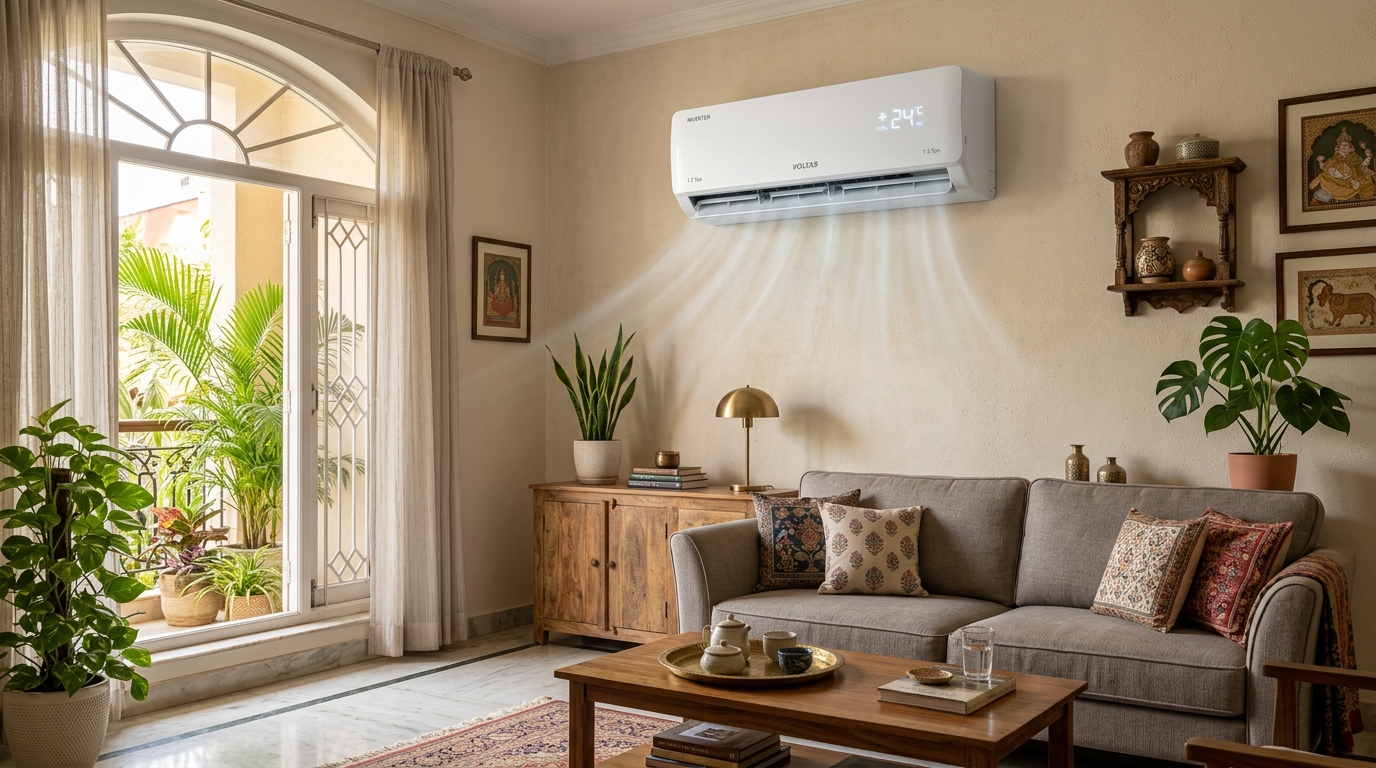
With extreme summer heatwaves pushing ambient temperatures past 48°C to 52°C across North, Central, and Western India, an air conditioner is no longer a luxury appliance—it is essential infrastructure for sleep, health, and productivity.
Our exhaustive Air Conditioner Buying Guide walks you through precise tonnage sizing for your room dimensions, the science of Dual Inverter variable-speed compressors, Bureau of Energy Efficiency (BEE 2026 ISEER) energy matrices, 100% grooved copper condenser protection for coastal and high-pollution belts, and multi-convertible cooling modes.
Contents at a Glance
1. AC Types & Form Factors: Split vs Window vs Portable
Choosing the correct architectural form factor is your first decision. It dictates acoustic comfort, architectural aesthetics, civil renovation requirements, and thermal efficiency:
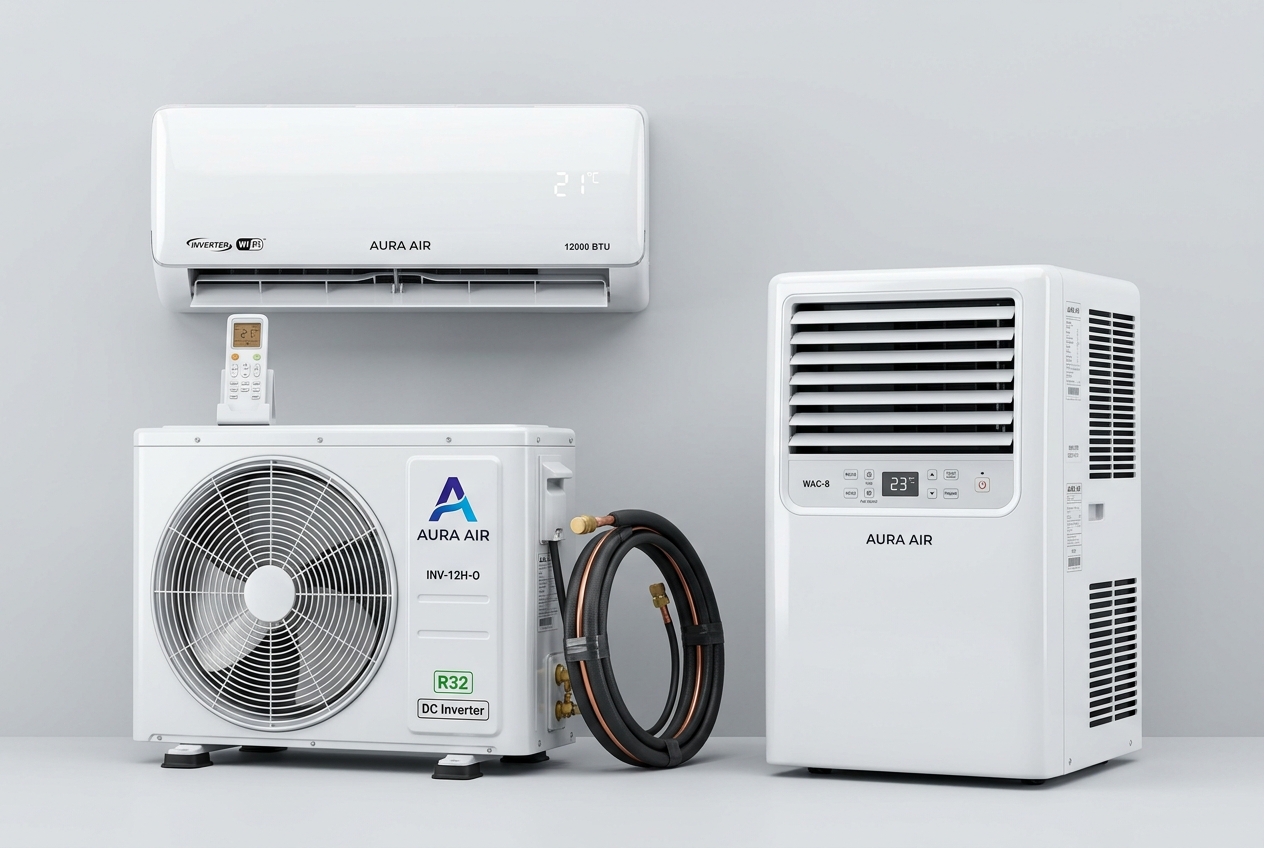
Inverter Split Air Conditioners
Composed of an indoor high-wall evaporator unit and an outdoor condensing compressor unit connected via insulated refrigerant copper pipes. Offers whisper-quiet operation (as low as 21 dB to 28 dB indoors) because the mechanical compressor sits outside the room. Modern split ACs deliver superior aesthetic blending, 4-way auto louver swing, multi-stage air filtration, and higher energy efficiency ratings (ISEER 5.0+).
Best for: Master bedrooms, living halls, modern apartments, and rental homes with balconies or designated outdoor AC ledges.
Window Air Conditioners
A self-contained single-chassis box housing the evaporator, blower, condenser coil, and compressor in one unit. Installed directly into an exterior window frame or designated 9-inch wall cutout. Window ACs eliminate lengthy copper piping runs and installation civil work. However, they generate noticeably higher indoor operational noise (44 dB to 54 dB) and block natural daylight through the window.
Best for: Rented accommodations, dedicated window cutouts in older buildings, small home offices, and budget-conscious purchases under ₹30,000.
Hot & Cold (Heat Pump) Split ACs
Equipped with a reversible 4-way refrigeration valve, Hot & Cold ACs function as ultra-efficient cooling systems during blistering 45°C summers and powerful convection room heaters during biting 2°C to 6°C North Indian winters (Delhi-NCR, Punjab, UP, Kashmir, Himachal). Because heat pump thermodynamics transfer thermal energy rather than running power-hungry heating elements, they consume up to 60% less electricity than oil-filled radiators (OFR) or halogen heaters.
Best for: Northern and Himalayan states experiencing extreme seasonal temperature swings.
Portable Air Conditioners
Freestanding castor-mounted units designed for plug-and-play operation. Requires an exhaust hose routed through an open window pane using a sliding seal kit to eject warm condenser exhaust air outdoors. While flexible, portable ACs have lower ISEER energy efficiency and higher compressor noise inside the living area.
Best for: Temporary workspaces, historical homes where building societies prohibit outdoor wall drilling, or exhibition booths.
2. Calculating Exact AC Tonnage for Indian Climate Conditions
In thermal engineering, 1 Ton of refrigeration does not refer to the weight of the air conditioner. It represents the heat removal capacity equivalent to melting 1 short ton (2,000 lbs / 907 kg) of pure ice at 0°C in 24 hours, equal to 12,000 BTU/hr (British Thermal Units per hour) or approximately 3,517 Watts of thermal cooling capacity.
Purchasing an undersized AC causes the compressor to run continuously at 100% capacity without ever reaching the setpoint temperature, driving up electricity bills. Conversely, an oversized AC cools the room too rapidly without running long enough to condense humidity out of the air, leaving the room cold yet clammy and humid.
| Floor Carpet Area | Standard Room (Middle Floor / Shaded) | Top Floor / Western Sun Exposure / Large Glass Windows | Recommended AC Tonnage |
|---|---|---|---|
| Up to 110 – 120 sq. ft. (e.g. 10 × 11 ft) | 9,000 – 12,000 BTU/hr | 12,000 – 14,000 BTU/hr | 0.8 Ton to 1.0 Ton |
| 120 – 180 sq. ft. (e.g. 12 × 14 ft) | 12,000 – 18,000 BTU/hr | 18,000 – 20,000 BTU/hr | 1.5 Ton (Sweet Spot for Indian Bedrooms) |
| 180 – 260 sq. ft. (e.g. 14 × 18 ft) | 18,000 – 24,000 BTU/hr | 24,000 – 26,000 BTU/hr | 2.0 Ton (Living Rooms & Large Master Suites) |
| 260 sq. ft. and Above | Dual units or Ductable Split | Two 1.5 Ton ACs or 2.5 Ton Heavy Commercial | 2 × 1.5 Ton or 1 × 2.5 Ton Multi-Split |
Crucial Heat Load Multipliers in India:
- Top Floor Roof Exposure: Add 0.5 Ton if your apartment sits directly beneath an un-insulated concrete roof terrace (chhat) exposed to direct sun throughout the day.
- West-Facing Glass Walls: Glazed balconies or floor-to-ceiling windows exposed to harsh afternoon sunlight require an extra 0.3 to 0.5 Ton capacity or heavy blackout thermal curtains.
- Occupancy & Electronics: Factor in approximately 400 BTU/hr per additional person beyond two occupants, plus heat emitted from large gaming PCs, 65-inch 4K TVs, and home theatre amplifiers.
3. Inverter vs Non-Inverter Compressor Physics
The compressor is the beating heart of an air conditioner, responsible for 80% to 90% of total electrical power consumption. Understanding inverter technology is essential for managing your monthly power bill:
Fixed-Speed (Non-Inverter) AC
Functions like a binary light switch: running at 100% full capacity or completely switched off (0%). Once the room hits the setpoint (e.g. 24°C), the compressor stops completely. When the room warms up to 26°C, it cranks back on with a massive inrush power surge. This cycle causes noticeable temperature spikes, loud clicking relays, heavy vibration, and high electricity bills.
Single Inverter AC
Uses a variable-frequency drive (VFD) and brushless DC (BLDC) motor that can dynamically throttle compressor speed between 30% and 100%. Once your desired temperature is reached, the compressor ramps down to an ultra-low frequency to continuously balance heat ingress, consuming as little as 300 to 500 Watts while maintaining a steady ±0.5°C temperature.
Dual Inverter / Twin Rotary Inverter AC
Employs two independent eccentric compression chambers rotating with a 180-degree phase shift on a single shaft. This dual-piston architecture balances mechanical forces, virtually eliminating vibration, reducing acoustic noise to sub-26 dB levels, and allowing an ultra-wide modulation range from 10% up to 115% overdrive capacity. Dual inverter models sustain peak cooling even in ambient outdoor heatwaves reaching 52°C to 54°C.
4. Bureau of Energy Efficiency (BEE) 2026 Star Ratings & ISEER Explained
In India, air conditioners are graded by the Bureau of Energy Efficiency (BEE) using the Indian Seasonal Energy Efficiency Ratio (ISEER). ISEER measures the total amount of heat an AC can remove from indoor air divided by the total electrical energy consumed over a standard operating profile reflecting diverse Indian climate seasons (temperatures ranging from 24°C to 43°C across 1,600 operating hours annually).
The Golden Rule: The higher the ISEER number, the more energy-efficient the AC. A 5-Star Split AC requires an ISEER of 5.00 or higher, whereas a 3-Star AC operates between 3.80 and 4.39.
| Star Rating (1.5 Ton Split) | Typical ISEER Range | Approx. Annual Power Consumption (1,600 hrs) | Est. Annual Power Cost (@ ₹8.50 / kWh) | Recommended Usage Profile |
|---|---|---|---|---|
| BEE 3-Star Inverter | 3.85 – 4.05 | 950 – 1,050 kWh / Units | ₹8,075 – ₹8,925 | 4 to 6 hours daily during 3 summer months |
| BEE 4-Star Inverter | 4.40 – 4.75 | 820 – 900 kWh / Units | ₹6,970 – ₹7,650 | 6 to 8 hours daily during 4–5 months |
| BEE 5-Star Inverter | 5.00 – 5.40+ | 700 – 780 kWh / Units | ₹5,950 – ₹6,630 | 8 to 16 hours daily, work-from-home, hot climate zones |
Initial Price Premium
A 5-Star 1.5 Ton Inverter AC typically costs ₹6,000 to ₹9,000 more than its 3-Star counterpart.
Annual Electricity Savings
Saving approximately 250 to 300 units per year at ₹8.50 per unit yields substantial recurring cash savings.
Capital Payback Period
If you run your AC 8+ hours a night throughout summer and monsoon, the 5-Star premium pays for itself in:
5. Condenser Coil Metallurgy: 100% Grooved Copper vs Aluminum
One of the most frequent points of failure in Indian air conditioners is refrigerant leakage due to coil corrosion. Understanding condenser metallurgy protects you against thousand-rupee repair bills:
100% Inner-Grooved Copper Coils
Copper exhibits nearly double the thermal conductivity of aluminum, ensuring faster heat dissipation and rapid room pulldown. More importantly, copper tubes can withstand high operating pressures (especially with eco-friendly R32 refrigerant), resist oxidation, and can be easily brazed and repaired by local technicians in the event of minor punctures. Inner rifling (grooving) inside the tubes increases the contact surface area of refrigerant flow, elevating thermal exchange efficiency by 20% to 30%.
Aluminum / Multi-Port Alloy Coils
While aluminum condenser coils lower the upfront manufacturing cost of budget air conditioners, they suffer from severe chemical vulnerabilities. Aluminum cannot be easily welded on-site; when pinhole leaks develop, the entire coil assembly must be replaced at steep cost. Aluminum is especially prone to galvanic corrosion when exposed to moisture and airborne salts.
Corrosion Protection for Indian Coastal & Urban Belts (Blue Fin / Gold Fin):
If you reside within 5 km of the sea (Mumbai, Chennai, Kochi, Goa, Vizag) or live near open municipal drains, industrial corridors, or heavy sewage channels (nullahs in Delhi-NCR, Bengaluru, Kolkata), airborne hydrogen sulfide (H2S) gas and saline moisture aggressively pit metal coils. Look for outdoor units treated with Gold Fin (hydrophilic gold epoxy resin) or Ocean Black Protection to prevent premature corrosion and gas leakage.
6. Essential Modern Features for Indian Homes
Evaluate these practical features that directly enhance day-to-day comfort and appliance longevity:
Multi-Mode Convertible Cooling (4-in-1, 6-in-1, Flexicool)
Allows you to electronically throttle down the AC's cooling capacity via the remote to 40%, 60%, 80%, 100%, or 110% overdrive. When you are alone in the room at night or during pleasant monsoon weather, capping capacity at 40% to 60% prevents overcooling and sharply reduces electricity draw.
Stabilizer-Free Operation (130V to 300V Wide Voltage Range)
Modern inverter ACs integrate heavy-duty metal oxide varistors (MOVs) and high-tolerance SMPS power supplies that absorb transient voltage spikes. If your locality experiences moderate fluctuation within 145V–280V, you can omit external stabilizers. However, for rural or peri-urban areas prone to severe brownouts below 130V or surges above 300V, a dedicated 4kVA voltage stabilizer remains recommended.
R32 Eco-Friendly Refrigerant
Ensure your chosen AC uses R32 refrigerant rather than older R410A or phased-out R22. R32 has a Global Warming Potential (GWP) of 675 (compared to 2,088 for R410A), zero Ozone Depletion Potential (ODP), and delivers higher volumetric capacity, requiring up to 30% less refrigerant charge per ton of cooling.
PM2.5 Air Purifying & Anti-Viral Filters
Combines high-density nylon mesh with micro-particulate electrostatic PM2.5 filters to trap airborne dust, pollen, and smog particles during hazy summer and monsoon seasons, improving indoor air quality while you sleep.
Smart Wi-Fi Connectivity & AI Temperature Control
Enables scheduling, power consumption tracking, geo-fencing (pre-cooling your room before you arrive home), and voice assistant control via Google Assistant and Amazon Alexa through companion mobile apps (LG ThinQ, Daikin Mobile Controller, Panasonic MirAIe).
7. Top Air Conditioner Brands in India (2026 Comparison)
Daikin
Global Japanese leader renowned for industrial-grade rotary compressors, Coanda airflow technology (directs chilled air toward the ceiling rather than blasting occupants directly), PM2.5 filtration, and whisper-quiet indoor units.
Voltas (A Tata Product)
India's highest-selling domestic brand engineered specifically for tropical Indian conditions. Outstanding cooling performance in extreme 50°C+ ambient heat, extensive tier-2/tier-3 service network, and accessible pricing.
LG Electronics
Pioneers of Dual Inverter technology in India with Ocean Black Fin anti-corrosion protection, 10-year compressor warranties, intuitive AI 6-in-1 convertible modes, and widespread nationwide service infrastructure.
Panasonic
Tech-forward Japanese brand distinguished by the MirAIe smart IoT app ecosystem, nanoe-X hydroxyl radical air purification (neutralizes airborne bacteria and odours), and premium copper build quality.
Mitsubishi Heavy / Electric
The gold standard for heavy-duty commercial and luxury residential cooling. Delivers massive CFM air throw (up to 15 meters), unmatched thermal build tolerances, and rock-solid reliability in large open halls.
Blue Star & Carrier
Commercial refrigeration stalwarts bringing industrial-grade durability to home splits. Featuring precision acoustic dampening, dual rotary compressors, and high ISEER ratings.
8. Pre-Purchase & Installation Checklist for Indian Homes
- ✓ Dedicated 16A Power Socket & MCB: Ensure your room features a dedicated 16-Ampere 3-pin socket wired with a minimum 2.5 sq. mm copper wire and an individual 16A or 20A Miniature Circuit Breaker (MCB) on the distribution board.
- ✓ Outdoor Unit Placement: Mount the outdoor unit on heavy-duty powder-coated wall brackets in a well-ventilated, shaded exterior area. Avoid enclosing the condenser in cramped grilles that trap hot exhaust air.
- ✓ Vacuuming During Installation: Insist that the installation technician uses a motorized vacuum pump to evacuate air and moisture from the copper refrigerant lines before opening the refrigerant valves. Trapped moisture reacts with compressor oil to form corrosive acid.
- ✓ Copper Piping Length: Ensure the connecting copper piping between indoor and outdoor units is between 3 meters (minimum for acoustic dampening) and 10 meters (maximum without requiring additional refrigerant top-up).
- ✓ Water Drainage Slope: Verify that the indoor unit's condensate drain pipe has a continuous downward slope to prevent water pooling, wall seepage, or indoor dripping.
Ready to discover the lowest prices and best seasonal deals on verified Inverter Air Conditioners?
Compare All Air Conditioner Prices →9. Frequently Asked Questions (FAQs)
Q1: What is the optimal temperature setting for maximum electricity savings in India?
24°C is the sweet spot. According to the Bureau of Energy Efficiency (BEE), every 1°C increase in temperature setting above 18°C saves approximately 6% on your electricity consumption. Setting your AC to 24°C provides ideal thermal comfort while reducing monthly power bills by 24% to 30% compared to running at 18°C.
Q2: Can I run a 1.5 Ton Inverter AC on a home solar inverter or DG genset?
Yes. Because modern inverter compressors ramp up gradually without drawing heavy initial starting current surges (inrush current), a 1.5 Ton inverter AC running in a reduced 40% to 60% convertible mode (drawing roughly 400W–700W) can comfortably operate on a 2.5kVA to 3.5kVA pure sine wave solar inverter or residential generator setup.
Q3: How often should I clean the AC filters and service the unit?
Indoor nylon mesh dust filters should be rinsed with running water every 2 to 3 weeks during peak summer operation. A comprehensive deep chemical wet-wash service of both indoor cooling fins and outdoor condenser coils should be performed twice a year—once before summer onset (March/April) and once after monsoon (September/October).
Q4: Why does my AC blow air but fail to cool during the afternoon?
Common culprits include an outdoor unit installed in direct unshaded 48°C+ sun causing thermal trip safety shutdowns, clogged condenser coils suffocating airflow, a faulty capacitor, or low refrigerant pressure due to micro-leaks in the copper piping.