



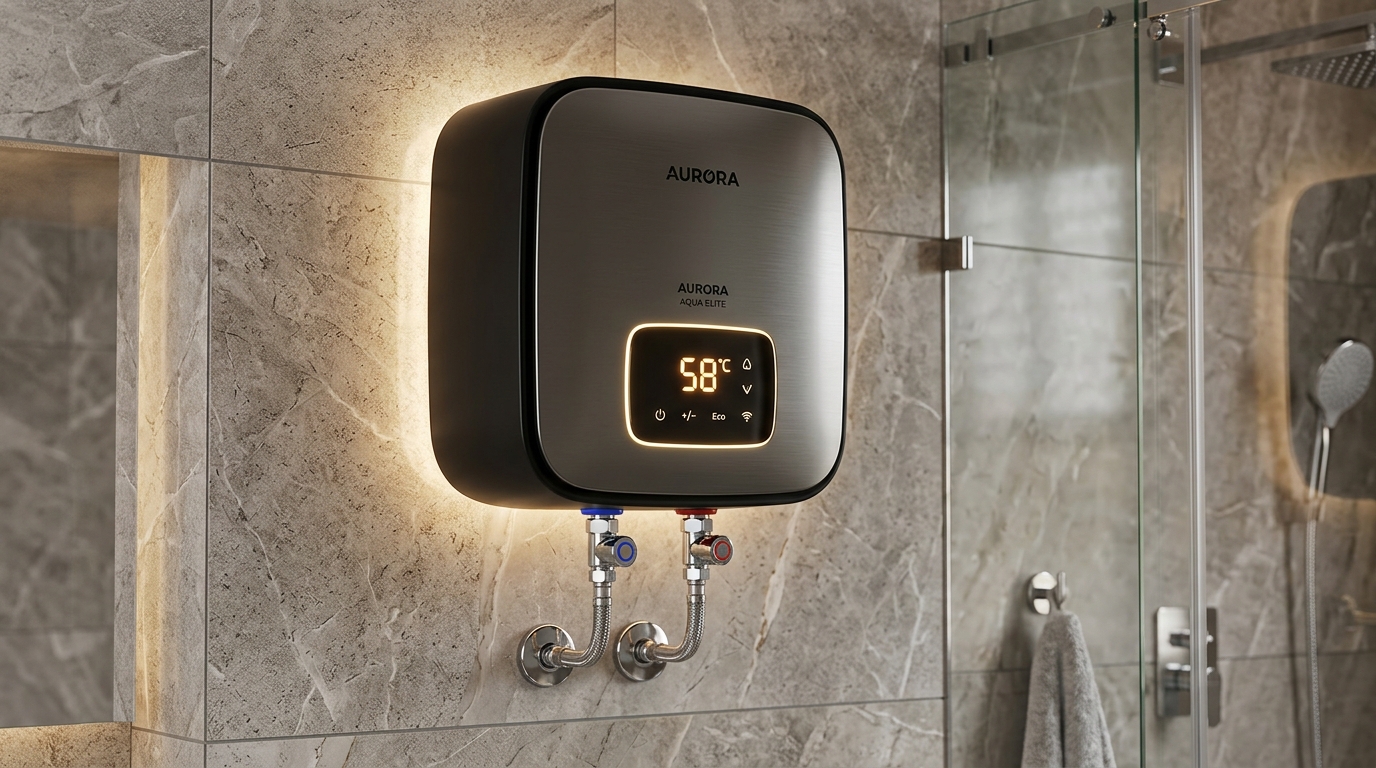
From biting North Indian winter mornings to monsoon chills and daily rejuvenating showers, a reliable water heater (geyser) is an essential comfort in every Indian bathroom. Yet, choosing the wrong geyser can lead to ruptured inner tanks under high-rise water pressure, scaled-up heating coils from hard borewell water, or staggering electricity bills.
Our comprehensive Water Heater & Geyser Buying Guide demystifies the engineering: Storage vs Instant vs Gas Geysers, 8-Bar pressure ratings for multi-story towers, vitreous enamel glass-lined tanks with sacrificial magnesium anodes for hard water, BEE 5-Star standing heat loss benchmarks, and critical electrical shock protection.
Contents at a Glance
1. Geyser Architecture: Storage vs Instant vs Gas
Understanding how water is heated and stored dictates its suitability for your bathroom layout and morning routine:
Storage Electric Geysers (10L – 35L)
Features an insulated inner water tank that heats a reservoir of water to 60°C–75°C using a 2000W heating element and holds it hot for hours using dense Polyurethane Foam (PUF) insulation. Delivers a steady, voluminous flow of hot water perfect for bucket baths, overhead rain showers, and bathtubs.
The Trade-off: Takes 12 to 20 minutes to heat up from cold, and occupies noticeable wall space.
Best for: Primary family bathrooms, overhead showers, and freezing winter regions. Price: ₹5,500 – ₹16,000.
Instant Electric Geysers (1L – 3L)
Compact, slimline units equipped with a high-power 3000W to 4500W heating element and a miniature 1 to 3-liter water jacket. Water heats on-demand as it passes through the coil, providing hot water within 30 to 60 seconds.
The Trade-off: Limited flow rate (2–3 liters per minute). Cannot supply hot water to high-flow rain showers or large buckets without the water turning lukewarm.
Best for: Kitchen sink dishwashing, guest washbasins, and quick single-bucket baths in mild climates. Price: ₹2,200 – ₹4,800.
Gas Geysers (LPG / PNG)
Uses liquefied petroleum gas (cylinder) or piped natural gas (PNG) to fire a heavy-duty copper heat exchanger. Heats continuous running water instantly without waiting for a tank to warm up and operates completely independently of electricity cuts.
The Trade-off: Requires dedicated exterior wall venting or a chimney flue to exhaust hazardous carbon monoxide (CO) gas. Strictly forbidden inside unventilated, windowless bathrooms.
Best for: Homes with piped natural gas connections, large joint families, or areas with frequent winter power outages. Price: ₹4,000 – ₹8,500.
2. Capacity Sizing Guide for Indian Households
Choosing an undersized geyser forces family members to wait 20 minutes between consecutive baths, while an oversized geyser wastes electricity heating unneeded volume:
| Capacity | Recommended Household Size | Bathing Method | Ideal Climate & Usage |
|---|---|---|---|
| 3 Liters (Instant) | Kitchen Sink / Washbasin | Dishwashing, face wash | Year-round kitchen use; bachelor quick wash |
| 10 Liters (Storage) | 1 to 2 Persons | Bucket Bath (1 bucket per cycle) | Southern & Coastal India (mild winters: Mumbai, Chennai, Bengaluru) |
| 15 Liters (Storage) | 2 to 3 Persons | Bucket Bath or 1 Quick Shower (5–8 mins) | Moderate winters; back-to-back bucket baths |
| 25 Liters (Storage) | 3 to 5 Persons (Sweet Spot) | Overhead Shower (10–15 mins) or 2–3 Buckets | Severe North Indian winters (Delhi NCR, Punjab, UP, Kashmir) & rain showers |
| 35 – 50 Liters | Large Families / Bathtubs | Luxury Rain Showers / Jacuzzi bathtubs | Continuous multi-member back-to-back long showers |
3. Hard Water, Corrosion & Inner Tank Technologies
Over 70% of urban Indian homes rely on borewell groundwater or private water tankers with Total Dissolved Solids (TDS) exceeding 500 to 1,500 ppm. Hard water contains dissolved calcium and magnesium carbonates that crystallize when heated, coating heating elements in heavy mineral scale and eating through tank welds:
Vitreous Enamel Glass-Lined Tanks (Mandatory for Hard Water)
Inner steel tanks coated with a fused liquid glass/ceramic glaze baked at 850°C (patented as Blue Diamond by AO Smith or Titanium Enamel by Racold). The non-porous glass barrier isolates water from the raw steel, preventing rust, pinhole leaks, and electrochemical pitting even with extreme borewell hardness.
Avoid plain 304 stainless steel or uncoated copper tanks in hard water zones, as chloride ions induce rapid weld seam corrosion within 2 to 3 years.
Sacrificial Magnesium Anode Rod
A heavy magnesium alloy rod submerged inside the water tank. Through galvanic electrochemical action, magnesium is more chemically active than iron, so corrosive minerals attack and dissolve the magnesium rod first, leaving the steel tank pristine.
Maintenance Tip: In areas with TDS above 800 ppm, have an authorized technician inspect and replace the sacrificial anode rod every 2 years to ensure lifelong tank protection.
Glass-Coated & Incoloy 800 Heating Elements
Standard copper heating elements corrode quickly in hard water, causing scale insulation that doubles electricity consumption and burns out the coil. Look for Incoloy 800 superalloy heating elements with a vitreous enamel glass coating that prevents limescale adhesion and maintains 100% heat transfer efficiency.
4. High-Rise Apartments & 8-Bar Water Pressure Ratings
In modern multi-story residential towers (10 to 40 floors) or homes equipped with automated booster pressure pumps, hydrostatic pressure on bathroom plumbing frequently reaches 6.0 to 7.5 Bar (kg/cm²).
- Insist on an 8-Bar (0.8 MPa) Rated Tank: Always verify that the geyser is explicitly rated for 8.0 Bar pressure. Older or cheaper geysers rated for 3 to 5 Bar will warp, leak at the gasket seals, or suffer catastrophic tank rupture under high-rise head pressure.
- Multifunction Safety Valve (MFV): Every high-rise geyser must include a factory-certified 4-in-1 or 5-in-1 MFV installed directly onto the cold water inlet. It functions as:
- Pressure Release Valve (PRV): Discharges excess internal steam pressure safely through a drain pipe if water exceeds 8 Bar.
- Non-Return Valve (NRV): Prevents hot water from flowing backwards into municipal cold water pipes during main supply cuts (dry-heating protection).
- Vacuum Release Valve: Prevents vacuum collapse when the tank empties.
5. BEE Star Ratings & Standing Heat Loss
A water heater does not just consume power when heating; it continuously loses heat through its tank walls 24 hours a day (known as Standing Loss):
| BEE Star Rating | Insulation Standard | Standing Loss (kWh/24 hrs) | Estimated Annual Energy Cost |
|---|---|---|---|
| BEE 5-Star (Recommended) | High-Density CFC-free Thick PUF (Polyurethane) | 0.38 – 0.46 kWh/day | ₹2,800 – ₹3,500 / year |
| BEE 4-Star | Standard PUF Insulation | 0.50 – 0.58 kWh/day | ₹3,600 – ₹4,400 / year |
| BEE 3-Star / Unrated | Thin Foam or Glass Wool | 0.75 – 1.10+ kWh/day | ₹5,500 – ₹7,200+ / year |
A 5-Star BEE rated geyser pays back its price premium within 18 to 24 months through standing energy savings alone.
6. Vertical vs Horizontal Mounting Orientation
Bathroom dimensions and false ceiling designs dictate the shape of your geyser:
Vertical Wall-Mounted (Recommended)
The standard tall cylindrical or square-rounded profile. Delivers optimal thermodynamic thermal stratification: hot water naturally rises to the top outlet while incoming dense cold water settles at the bottom, delivering consistent hot water temperature until the very last liter.
Horizontal Wall-Mounted (For Low Ceilings)
Engineered for compact modern bathrooms with low false ceilings or overhead beams where a 2-foot vertical tank will not fit. Features specialized internal baffle dip tubes to prevent cold water from mixing prematurely with hot water.
7. Safety Systems & Electrical Shock Protection
Essential Bathroom Safety Checklist
- Capillary Thermostat & Thermal Cutout: The primary thermostat regulates water temperature between 30°C and 75°C. If the thermostat fails, a secondary independent thermal cutout trips at 90°C to cut power completely, preventing dangerous steam explosions.
- Shock-Proof Rust-Proof Outer Body: High-grade virgin ABS thermoplastic outer body prevents electrical shock hazards in humid shower environments and will never corrode or rust from bathroom moisture.
- ELCB / PRCD (Earth Leakage Protection Plug): Look for models equipped with a built-in Portable Residual Current Device (PRCD) power cord plug. If current leaks into water (even as low as 10mA to 30mA), the PRCD cuts electricity in less than 0.05 seconds, preventing fatal electric shocks.
- Dedicated 16 Amp Electrical Socket: Always connect your water heater to a heavy-duty 16-Amp 3-pin power point wired to a dedicated 16A MCB with proper copper earth grounding. Never use flimsy 6A multi-plugs or extension strips.
8. Top Water Heater Brands in India
- AO Smith: The global pioneer in water heating technology. Famous for proprietary Blue Diamond glass-lined tanks, custom Incoloy heating elements, and extended 7-year tank warranties—the ultimate hard-water specialist.
- Racold: Italy's premier water heating specialist with massive market presence in India. Renowned for Titanium Plus enamel coatings, compact horizontal designs, and intelligent Smart Bath logic.
- Havells: Offers sleek cube-shaped aesthetic designs, Feroglass coated tanks, digital color-changing LED temperature rings, and integrated shock-safe PRCD plugs.
- Crompton: The value-for-money champion (Arno Neo, Solarium Qube series) with 1200gm superior heating elements, 8-bar pressure ratings, and reliable pan-India after-sales service.
- Bajaj: Trusted household brand offering durable titanium armour tanks, Marine-grade coatings, and budget-friendly instant and storage models across India.
- Venus: South India's veteran manufacturer renowned for porcelain enamel tanks and robust industrial reliability.
- V-Guard: Exceptional build quality for tough groundwater conditions, featuring EPAC tank coatings and dual-indicator displays.
9. Frequently Asked Questions
Q1. How much electricity does a 25-litre storage geyser consume per bath?
A standard 25-litre storage geyser with a 2,000-Watt (2 kW) element takes approximately 20 to 25 minutes to heat a full tank of water from 15°C to 65°C. This consumes approximately 0.7 to 0.8 units (kWh) of electricity, costing around ₹5 to ₹7 per full bath cycle depending on your state electricity tariff.
Q2. Is it safe to leave a storage geyser switched ON all day?
While modern 5-star geysers have auto-cut thermostats and thick PUF insulation to keep water hot, leaving the geyser turned ON 24x7 causes the heating element to cycle ON and OFF every few hours to offset standing heat loss. This wastes 1 to 1.5 units of electricity daily and degrades heating element lifespan. It is best to turn the geyser ON 15–20 minutes before bathing, or use a smart Wi-Fi geyser to automate daily schedules.
Q3. Can I install an Instant Geyser (3 Litres) for my bathroom shower?
No. Instant geysers heat only 2 to 3 liters of water at a time with a flow rate of about 2 liters/minute. An overhead rain shower or multi-flow hand shower requires 6 to 10 liters of water per minute. If connected to a shower, the water will quickly turn cold and uncomfortable. Always choose a 15-litre or 25-litre storage geyser for shower baths.
Q4. Why is water dripping from the Multifunction Safety Valve (MFV) pipe?
Mild dripping of a few water drops during the heating cycle is completely normal. Water expands in volume when heated; the safety valve releases this small volume expansion to prevent internal tank pressure from exceeding safe 8-Bar thresholds. If water gushes continuously even when the geyser is cold, the building water pressure is exceeding 8 Bar, requiring a Pressure Reducing Valve (PRV) on your main bathroom inlet.
Q5. Are gas geysers safe to install inside bathrooms in India?
Gas geysers consume room oxygen to burn LPG/PNG and produce toxic carbon monoxide (CO) gas. In an enclosed, poorly ventilated bathroom with fogged windows, carbon monoxide buildup can cause dizziness, suffocation, and fatal asphyxiation. Gas geysers should ideally be installed on an open balcony or exterior utility terrace with hot water piped into the bathroom, or installed strictly with a continuous mechanical exhaust flue.