



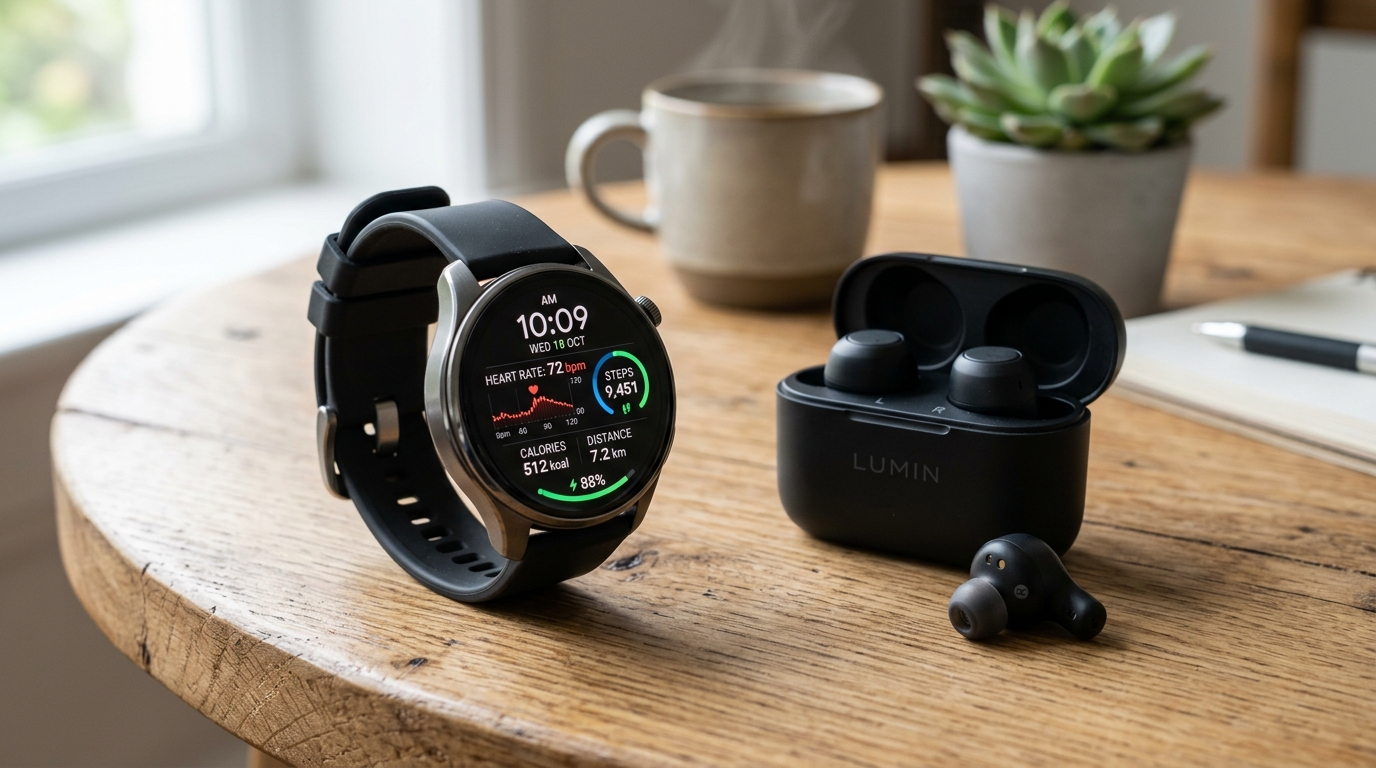
Smartwatches in India have evolved from simple digital pedometers into vital daily companions: managing hands-free Bluetooth phone calls on crowded commutes, logging heart rate and sleep patterns, tracking outdoor runs under the blazing sun, and even delivering standalone 4G connectivity.
Our comprehensive Smartwatch Buying Guide cuts through marketing hype to explain the crucial differences between Wear OS / watchOS vs RTOS (Real-Time OS), AMOLED outdoor brightness under harsh Indian sunlight, sensor accuracy for heart rate and SpO2, dual-frequency GPS, and realistic battery endurance.
Contents at a Glance
1. Operating System: Full Smartwatch vs Smart Fitness Band (RTOS)
The single most important decision when buying a wrist wearable is determining whether you need a true smartwatch with an app store or a real-time operating system (RTOS) tracker with phone notifications:
Wear OS & Apple watchOS
Powered by robust processors (Snapdragon W5+ Gen 1, Exynos W1000, Apple S9/S10) and full-fledged app ecosystems. You can download apps directly from Google Play or Apple App Store, reply to WhatsApp messages using an onscreen keyboard or voice dictation, stream Spotify music offline to Bluetooth earbuds, navigate turn-by-turn on Google Maps, and make tap-and-pay UPI/card payments via NFC.
The Trade-off: High compute demand means battery life is typically 24 to 48 hours, requiring daily or every-other-day charging.
Examples: Apple Watch Series 9/10/SE, Samsung Galaxy Watch 6/7/Ultra, OnePlus Watch 2.
Proprietary RTOS (Real-Time OS)
Runs lightweight, closed-source firmware optimized for energy efficiency. Handles basic notifications, timer/stopwatch, weather alerts, music playback control on your smartphone, and daily fitness tracking. You cannot install third-party apps, download Spotify offline tracks, or type out free-form custom replies to messages (only pre-set canned SMS replies on Android).
The Advantage: Outstanding battery endurance—lasting between 7 to 15 days on a single charge.
Examples: Amazfit Active/GTR, Garmin Forerunner, OnePlus Nord Watch, Noise, boAt, Fire-Boltt.
| Feature | Wear OS / watchOS | Mid-Range RTOS (Amazfit / Garmin) | Budget RTOS (Under ₹3,000) |
|---|---|---|---|
| Third-Party Apps | Full Play Store / App Store access | Curated lightweight mini-apps / widget store | None (Fixed firmware) |
| Message Replies | Voice dictation, QWERTY keyboard, emoji | Quick canned replies (Android only) | Read-only or canned responses |
| Battery Life | 1 to 3 days (Dual-engine hybrids up to 4 days) | 7 to 14 days | 5 to 10 days |
| NFC / Contactless Pay | Google Wallet / Apple Pay supported | Garmin Pay (select cards) / Zepp Pay | Not available |
| Typical Price (INR) | ₹18,000 – ₹65,000 | ₹7,000 – ₹35,000 | ₹1,200 – ₹4,000 |
2. Display & Build Quality: Legibility Under Indian Sunshine
In Indian summers, outdoor ambient sunlight regularly exceeds 50,000 lux. A screen that looks bright in a showroom can become completely unreadable outdoors if it lacks sufficient luminance:
- AMOLED vs TFT/LCD Displays:
- AMOLED (Recommended): Delivers individually illuminated pixels with true ink-black contrast, vibrant colors, and power-efficient Always-On Display (AOD) modes. Look for displays rated at 600 to 1,000+ nits peak brightness for effortless readability when walking or riding a two-wheeler outdoors.
- TFT / LCD: Common on budget watches below ₹2,000. Utilizes a constant backlight, making blacks appear grayish and draining battery rapidly if kept active. Often suffers from washed-out viewing angles in direct sunlight.
- Refresh Rate (30Hz vs 60Hz): Budget models often run at 30Hz or 40Hz, causing visible stutter when scrolling through notification lists or watch faces. Look for smooth 60Hz refresh rate panels on watches above ₹2,500.
- Cover Glass Protection: Mineral glass or generic acrylic scratches easily on doorframes and zippers. Look for Panda Glass, Corning Gorilla Glass, or Sapphire Crystal (on premium watches) to prevent unsightly scratches during daily Indian transit.
- Case Material & Sweat Resistance: High-grade polycarbonate or aerospace aluminum keeps the watch lightweight for 24/7 sleep tracking. Ensure the strap is skin-friendly fluoroelastomer or liquid silicone, which will not trap sweat or cause contact dermatitis during humid monsoons.
3. Bluetooth Calling vs Cellular LTE eSIM
Bluetooth calling has become a standard consumer expectation in India. However, the hardware implementation drastically impacts call clarity and connection stability:
Single-Chip Bluetooth 5.3 Calling
Older smartwatches required connecting two separate Bluetooth profiles in your phone settings—one for notifications and another for audio—which drained smartphone battery and frequently dropped calls. Modern 2026 smartwatches feature a single-chip BT SoC (Bluetooth 5.2/5.3) that pairs audio and telemetry over a single unified link, dramatically improving connection range and battery longevity.
Ensure the watch includes a directional microphone with environmental noise cancellation (ENC) and a built-in acoustic speaker cavity so you can hear callers clearly in traffic or ambient office chatter.
Standalone 4G / LTE eSIM
Equipped with an onboard cellular modem and virtual eSIM that mirrors your primary smartphone phone number (supported by Jio and Airtel in India). Enables receiving calls, sending messages, and streaming music even when your phone is left at home during morning jogging or grocery runs.
Considerations: Requires a monthly cellular wearable add-on plan from your telecom carrier and increases watch standby battery drain by 25%–40% when operating on mobile data.
4. Health Sensors & Metric Accuracy: Real vs Gimmick
Not all health sensors are created equal. In the ultra-budget segment, several sub-₹1,500 watches use low-grade infrared LEDs paired with crude predictive software algorithms that can produce "normal" heart rate readings even when strapped to a cardboard roll or desk.
What to Look for in Sensor Tech
- Optical PPG Heart Rate: Look for multi-channel sensor arrays (such as BioTracker by Amazfit or 4-channel photodiode clusters) that measure blood volume pulses reliably across diverse Indian skin tones and wrist hair densities.
- Continuous vs Spot-Check SpO2: Blood oxygen monitoring is valuable for respiratory baseline tracking and high-altitude travel (e.g., Ladakh trips). Budget watches only take manual 30-second spot checks, whereas advanced watches monitor continuously overnight to detect desaturation dips.
- Sleep Architecture Analysis: Advanced trackers break down sleep into Deep, REM, and Light stages, alongside awake interruptions and respiratory rate. Premium platforms (Apple, Samsung, Garmin) correlate sleep metrics with resting heart rate and Heart Rate Variability (HRV) to compute a morning "Readiness Score."
- Medical-Grade ECG & Blood Pressure: Single-lead ECG sensors (found on Apple Watch Series 8/9/10 and Samsung Galaxy Watch 5/6/7) can screen for signs of Atrial Fibrillation (AFib). While not a replacement for a hospital 12-lead ECG, they offer clinically validated early detection alerts.
5. GPS Precision & Water Resistance Standards
For outdoor running, cycling, trekking, and swimming, dedicated hardware tracking makes a critical difference:
Built-In GPS vs Connected GPS
Connected GPS: The watch has no internal GPS receiver; it simply borrows coordinates from your paired smartphone's GPS over Bluetooth. If you run without your phone, your route map and outdoor pace cannot be recorded.
Standalone Built-In GPS: The watch houses its own satellite antenna. For runners in dense Indian metropolitan cities with towering high-rises and flyovers, look for Dual-Band L1 + L5 GNSS (supporting GPS, GLONASS, Galileo, and India's NavIC) to prevent satellite multipath drift and pace clipping.
Water Resistance Ratings Demystified
- IP67: Resistant to dust and splashes. Safe against accidental rain and handwashing, but not safe for showering or swimming.
- IP68: Withstands immersion up to 1.5 meters in still freshwater for 30 minutes. Fine for intense monsoon rain and sweat, but not certified for dynamic water velocity.
- 5 ATM (50m ISO 22810): The gold standard for swimming watches. Safe for pool laps, surface water sports, and beach swimming (rinse with freshwater afterwards to remove chlorine/salt).
6. Battery Life vs Daily Convenience
Battery life is the most frequent source of buyer remorse. Understand what your daily charging routine will look like before finalizing a purchase:
| Watch Category | Typical Real-World Battery | Charging Frequency | Ideal Lifestyle |
|---|---|---|---|
| Apple Watch / Samsung Galaxy Watch | 18 to 36 hours (AOD enabled) | Daily (e.g., during morning shower) | Tech enthusiasts wanting full app power, dictation replies & NFC |
| Dual-Engine Wear OS (OnePlus Watch 2) | 3 to 4 days (Smart mode) / 12 days (Power-save) | Twice a week | Users wanting Google Wear OS with weekend endurance |
| Performance Fitness (Amazfit / Garmin) | 7 to 16 days (Continuous HR + Sleep) | Once every 10–14 days | Runners, gym-goers, travellers who hate daily chargers |
| Budget Calling Watches (Noise / boAt) | 3 to 5 days (BT calling active) | Twice a week | Budget-conscious users prioritizing Bluetooth phone calls |
7. Smartwatch Price Segments in India (2026)
Under ₹2,500: Fashion & Basic Calling
Equipped with large 1.8"–2.0" TFT or entry-level AMOLED screens, Bluetooth calling, customizable watch faces, step counter, and basic notification mirroring. Sensor accuracy is approximate and build uses polycarbonate plastic. Excellent starter gift or everyday casual accessory.
Key Players: Noise ColorFit, boAt Wave, Fire-Boltt, Fastrack Reflex.
₹2,500 – ₹8,000: AMOLED & Built-In GPS
Brings sharp 60Hz AMOLED displays with 1,000 nits brightness, metal alloy cases, accurate multi-channel optical heart rate sensors, continuous SpO2, comprehensive sleep stage breakdown, and built-in standalone GPS on models near ₹6,000. Delivers 7 to 12 days of battery life.
Key Players: Amazfit Bip 5 / Active, CMF by Nothing Watch Pro, OnePlus Nord Watch.
₹15,000 – ₹50,000+: True Smartwatch & Sports
Full OS platforms (Wear OS, watchOS) with Google Assistant / Siri, third-party apps, wireless charging, sapphire crystal glass, clinical ECG, and optional 4G LTE. Dedicated athlete watches in this tier (Garmin Forerunner, Fenix) feature transflective solar displays, offline topographic maps, and ultra-precise dual-frequency GNSS.
Key Players: Apple Watch Series 9/10/SE, Samsung Galaxy Watch 6/7/Ultra, Garmin, OnePlus Watch 2.
8. Top Smartwatch Brands in India
- Apple: The undisputed gold standard for iPhone users. Unmatched haptic feedback, fluid animations, medical-grade heart health algorithms, fall and crash detection, and seamless ecosystem integration. (Note: Apple Watches do not work with Android phones).
- Samsung: The premier Wear OS smartwatch for Android users. Features vibrant Super AMOLED screens, Samsung BioActive sensor (ECG, BIA body composition), Google Play Store, and elegant rotating bezels on Classic models.
- OnePlus: Innovator of the "Dual-Engine Architecture"—running Wear OS on a Snapdragon chip alongside an ultra-low-power RTOS coprocessor—achieving an unprecedented 100-hour battery life with full Wear OS app capability.
- Amazfit: The benchmark for mid-range fitness enthusiasts. Highly accurate Zepp OS tracking, superb battery endurance (7–14 days), built-in GPS, and lightweight designs compatible with both Android and iOS.
- Garmin: The definitive choice for marathon runners, triathletes, and outdoor adventurers. Features transreflective solar displays visible in direct sunlight, weeks of battery life, and advanced training load / VO2 Max analytics.
- Noise & boAt: India's homegrown volume leaders dominating the sub-₹3,000 category with stylish metallic cases, bright AMOLED panels, and reliable Bluetooth phone calling.
9. Frequently Asked Questions
Q1. Can I use an Apple Watch with an Android smartphone?
No. Apple Watch requires an iPhone (iPhone 8 or later running recent iOS) for initial setup, syncing, health telemetry, and app installation. If you use an Android smartphone, choose a Wear OS watch (Samsung Galaxy Watch, OnePlus Watch 2) or an RTOS device (Amazfit, Garmin).
Q2. Can I make UPI payments directly from my smartwatch in India?
Smartwatch UPI tap-and-pay is limited in India. True smartwatches running Wear OS with Google Wallet or Apple Watch support NFC contactless debit/credit card payments at PoS machines with participating Indian banks (HDFC, SBI, ICICI, Axis). For direct QR-code scanning or UPI PIN payments, smartwatches are generally not suitable due to small screen cameras, though some companion apps display static receiving QR codes.
Q3. Are budget smartwatches under ₹2,000 accurate for measuring blood pressure and SpO2?
No. Blood pressure claims on watches under ₹5,000 are estimated via optical algorithm guesses rather than oscillometric inflation cuffs and must not be used for medical decisions. While SpO2 sensors on reputable brands offer helpful recreational benchmarks, always rely on a calibrated medical fingertip pulse oximeter or blood pressure monitor for clinical healthcare monitoring.
Q4. Does Bluetooth calling drain the watch battery quickly?
Yes. Continuous Bluetooth phone calls use the onboard speaker and amplifier at high power. While a typical RTOS watch lasts 7 to 10 days on standby, active calling of 20 to 30 minutes per day will reduce total battery endurance down to 3 to 4 days.
Q5. Can I swim with an IP68 rated smartwatch?
No. IP68 certification is tested under stationary freshwater conditions without movement pressure. Swimming creates dynamic hydrodynamic pressure spikes that can breach watch rubber seals. For swimming laps in pools or lakes, always choose a watch with a certified 5 ATM or 10 ATM water resistance rating and a dedicated swim-tracking mode.