



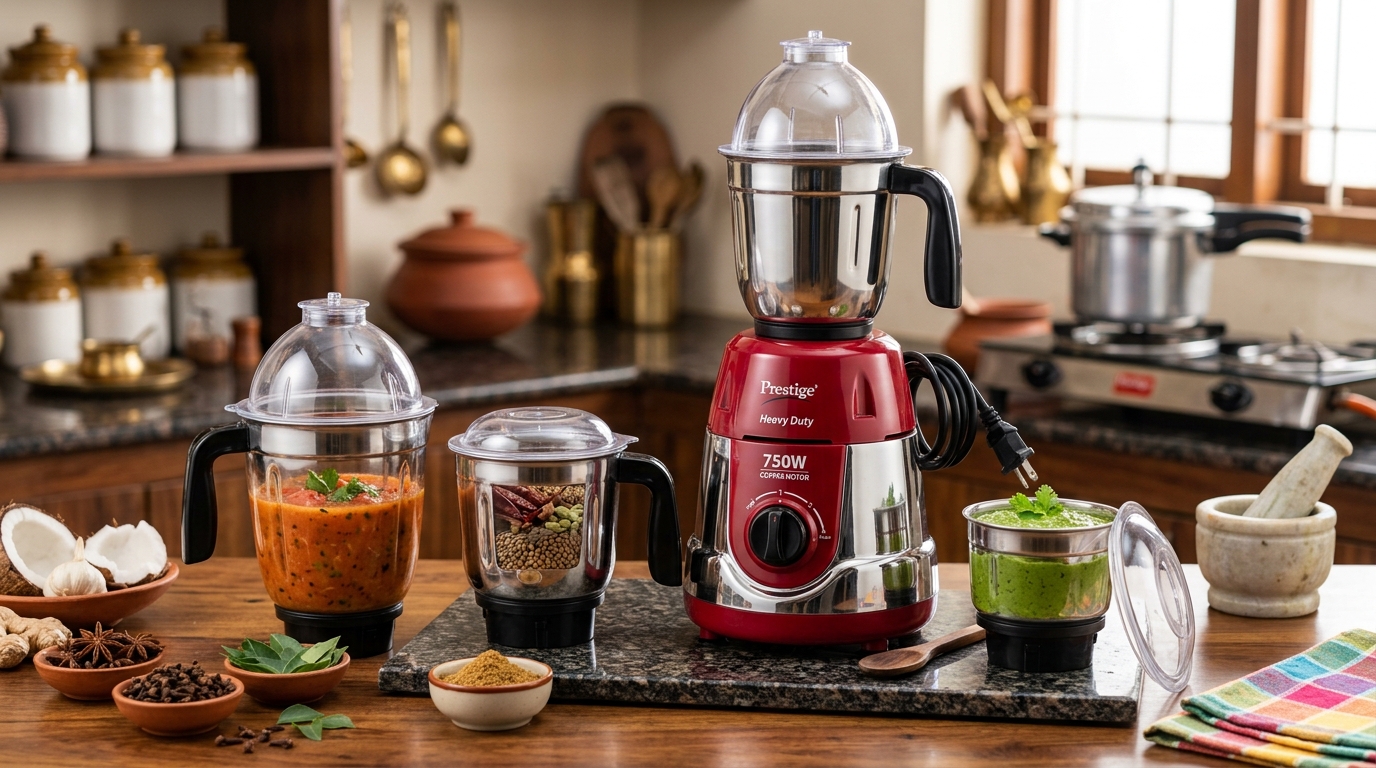
No appliance works harder in an Indian home than the mixer grinder. From pulverizing rock-hard turmeric roots and whole garam masalas to grinding thick, viscous fermented idli-dosa batter and churning fresh coconut chutney at dawn, it is the beating heart of Indian culinary preparation.
Our comprehensive Mixer Grinder Buying Guide examines the engineering essentials: Motor Wattage (500W vs 750W vs 1000W), 100% copper windings vs CCA, torque vs RPM, 304 stainless steel jars with flow breakers, acoustic noise-dampening technology, and safety overload protection.
Contents at a Glance
1. Motor Wattage: Matching Power to Your Kitchen Demands
Motor wattage dictates how much mechanical torque the machine can generate when tackling dense, resistant ingredients without overheating or tripping circuit breakers:
500 Watts: Basic Spices & Pastes
Equipped with a compact motor suited for bachelor pads, nuclear couples, or light cooking. Effortlessly prepares daily ginger-garlic paste, tomato purees, coriander chutney, and milkshakes. However, struggles with heavy loads—frequently stalling or tripping the thermal overload switch when asked to grind soaked urad dal or hard dry spices.
Best for: Small households with minimal wet batter grinding needs. Price: ₹1,500 – ₹2,800.
750 Watts: The All-Rounder Sweet Spot
The definitive benchmark for 90% of Indian families. Delivers abundant rotational torque to grind thick idli, dosa, and vada batter in 4 to 6 minutes, pulverize whole roasted coriander and cumin seeds into velvety garam masala, and grate tough fresh coconut flesh without slowing down.
Best for: Medium to large Indian households cooking daily regional meals. Price: ₹2,800 – ₹5,500.
900 – 1000+ Watts: Unstoppable Power
Houses industrial-grade motors capable of pulverizing bone-dry raw turmeric fingers (sukhi haldi), making dense homemade peanut and almond butter, crushing ice, and extracting cold-pressed vegetable juices. Features continuous duty-cycle ratings (up to 90–120 minutes of non-stop operation without burning out).
Best for: Large joint families, home caterers, and baking/fitness enthusiasts. Price: ₹5,500 – ₹12,000.
2. Motor Architecture: 100% Copper vs RPM vs Torque
A mixer grinder's lifespan depends entirely on the quality of its internal electro-mechanical winding:
- 100% Pure Copper Windings (Mandatory): Always verify that the manufacturer specifies 100% copper motor windings. Cheap budget grinders use copper-coated aluminum (CCA) wire, which suffers from high internal electrical resistance, overheats rapidly under resistance loads, and burns out within 1 to 2 years. Pure copper handles thermal expansion gracefully, ensuring 7 to 10+ years of uninterrupted daily service.
- Torque vs High RPM: High speed (RPM) and torque are inverse forces:
- Dry Grinding (Spices): Requires high rotational speeds (18,000 to 22,000 RPM) to smash dry brittle coriander and pepper against the steel jar walls into micron-fine powder.
- Wet Grinding (Batters): Demands high low-end torque at moderate speeds (10,000 to 14,000 RPM). If a motor lacks torque, the heavy, thick viscous dal batter creates massive hydraulic drag, slowing the blade to a crawl and causing the motor to smoke.
- Speed Control & Inching / Pulse Function: Ensure the front rotary switch provides at least 3 distinct speed settings (Low, Medium, High) plus a momentary Pulse / Whip toggle. The pulse mode is indispensable for coarse mincing onions, whipping lassi, or dislodging stuck ingredients before starting a full cycle.
3. Jar Sizing & 304 Food-Grade Stainless Steel
Most mixer grinders ship with 3 to 4 modular jars. Examine the gauge and grade of steel before buying:
| Jar Type | Typical Capacity | Recommended Application |
|---|---|---|
| Chutney / Spice Jar | 0.4 to 0.5 Liters | Coconut chutney, green mint-coriander paste, ginger-garlic paste, grinding whole cloves/cardamom |
| Dry Grinding Jar | 0.8 to 1.0 Liters | Garam masala, sambar powder, roasted lentils, raw turmeric, red chilli flakes, coffee beans |
| Wet Grinding Jar | 1.2 to 1.5 Liters | Idli and dosa batter, tomato purees, besan batter for pakoras, gravies, pancake batter |
| Juicer / Extractor Jar | 1.5 to 1.75 Liters | Transparent polycarbonate jar with internal stainless steel pulp filter mesh for fresh fruit/citrus juice |
Insist on Grade 304 Stainless Steel
Ensure jars are stamped with AISI 304 Food-Grade Stainless Steel. Indian food ingredients (lemons, tamarind, vinegar, rock salt, tomatoes) are highly acidic. Inferior 200-series steel will develop rust pitting, chemical staining, and toxic metallic leeching over time. 304 steel is completely impervious to food acid oxidation.
4. Blade Engineering & Jar Flow Breakers
The synergy between blade shape and jar wall geometry dictates grinding speed and texture:
Flow Breaker Grooves
Notice the vertical ridges stamped into the inner walls of quality stainless steel jars. These are flow breakers. As high-speed blades spin ingredients into a centrifugal whirlpool, flow breakers disrupt the vortex, forcing ingredients back down toward the center blades. Jars with flat, smooth walls allow food to stick to the perimeter while blades spin empty in the center.
Specialized Blade Geometries
Look for machines featuring thick, machine-ground stainless steel blades: flat 2-prong blades for chutney paste, 4-prong curved serrated blades for heavy wet grinding, and specialized blunt-edge blades (like Bosch's PoundingBlade) that crush spices with blunt force rather than cutting, preserving the authentic rough-ground aroma of stone mortar and pestle.
5. Safety Overload Switches & Coupler Durability
Heavy grinding creates mechanical stress. Look for these essential protection mechanisms:
- Thermal Overload Protector (OLP): Located on the bottom base of the machine. If the motor reaches dangerous thermal levels due to dry friction or overfilling, the red OLP switch trips automatically, cutting power to prevent armature burnout. After cooling for 2–3 minutes and reducing the jar load, simply press the red reset button underneath to resume work.
- Jar Lid Interlock Mechanism: A premier safety feature that prevents the motor from spinning unless the jar is locked onto the motor base and the lid clips are firmly clamped down—preventing messy kitchen ceiling splatters or accidental finger contact.
- Coupler Material Quality: The coupler is the interlocking toothed plastic/rubber gear that transfers rotational energy from the motor shaft to the jar blade. Opt for high-density nylon or neoprene rubber couplers with solid brass inserts. Cheap plastic couplers strip their teeth within months if a jar is removed while the motor is still spinning.
6. Acoustic Noise Levels & Silent Mixers
Traditional Indian mixer grinders roar at 85 to 90 decibels (dB)—comparable to a loud lawn mower or heavy traffic—often waking sleeping family members during early morning breakfast preparation.
Modern silent mixer grinders (such as the Preethi Zodiac 2.0 Silent or Philips Super Silent series) feature dual-walled acoustic motor enclosures, decoupled vibration-absorbing rubber feet, and aerodynamically optimized air cooling intake channels that bring operating noise down to 68 to 72 dB, allowing normal conversation while blending.
7. Top Mixer Grinder Brands in India
- Sujata: The undisputed heavyweight champion of raw grinding power. Trusted by domestic kitchens, commercial juice shops, and street stalls across North India. Famous for indestructible 900W 100% copper motors that run for 90 continuous minutes without breaking a sweat.
- Preethi: South India's premier kitchen brand. Renowned for the legendary Blue Leaf and Zodiac multi-functional food processor series (mastering atta kneading, onion slicing, and citrus juicing in seconds). Excellent after-sales service and spare parts availability.
- Bosch: German engineering tailored for Indian cooking with the TrueMixx series. Features unique blunt PoundingBlades, stone-pounding technology, high-grade 304 steel jars, and hands-free lid locking clamps.
- Philips: Delivers sleek, modern, aesthetically refined mixer grinders with superb airflow cooling, silent motor engineering, and dishwasher-safe modular attachments.
- Butterfly: Offers exceptional budget-to-midrange value with the Jet and Desire series, known for sturdy stainless steel jars and reliable copper-wound motors.
8. Care, Maintenance & Longevity Best Practices
How to Make Your Mixer Grinder Last 10+ Years
- The 60% Capacity Rule: Never fill a jar more than 60% full, especially with liquids or expanding urad dal batter. Wet batter expands with aerated foam during high-speed blending and can breach the rubber lid gasket.
- Cool Down Roasted Spices: Never pour piping-hot, freshly roasted whole spices directly into the grinding jar. Heat creates high vapor pressure inside the sealed lid, which can blow the lid off or damage motor bearing seals. Always cool roasted spices to room temperature before powdering.
- Water Drop Technique for Blades: After washing jars, turn them upside down to dry. Add a drop of edible cooking oil to the underside blade shaft once every two months to keep the bronze oil-bush bearings lubricated.
- Never Run Completely Dry Empty: Running a dry stainless steel jar with no ingredients inside damages the bronze bushings and warps the blade balance due to lack of load resistance.
9. Frequently Asked Questions
Q1. Why does a brand-new mixer grinder smell like burning on its first few uses?
Do not panic—this is completely normal. Brand-new copper motor windings are coated in an insulating varnish at the factory. During the first 2 to 3 grinding cycles, the heat generated by the motor cures and evaporates this varnish layer, emitting a faint burning odor. If the smell persists after 4 to 5 uses or is accompanied by smoke, contact customer service immediately.
Q2. Can a 750W mixer grinder crush hard raw dry turmeric (sukhi haldi)?
While a quality 750W copper motor can grind turmeric if broken down into pea-sized bits first, repeatedly grinding large rock-hard raw turmeric roots will dull blades and strain the motor. If your household regularly grinds whole dry turmeric roots and raw spices from scratch, invest in a 900W to 1000W heavy-duty motor (like Sujata Dynamix or Powermatic).
Q3. What should I do if the mixer grinder suddenly shuts off while grinding?
When the machine shuts down abruptly under heavy load, the red thermal overload switch on the bottom base has tripped to save the motor from burning out. Unplug the mixer from the wall, remove the jar, scoop out one-third of the dense batter, and wait 3 to 5 minutes for the motor to cool. Then, invert the base, press the red reset button firmly until it clicks, and restart on speed 1.
Q4. What is the difference between a Mixer Grinder and a Food Processor?
A mixer grinder is specialized for high-speed pulverizing, dry spice powdering, chutneys, and batter grinding. A food processor includes a wide transparent processing bowl with interchangeable disc blades designed for low-speed mechanical tasks: slicing cucumbers, shredding carrots, chopping onions without tears, and kneading wheat dough (atta) for rotis.
Q5. Why do jar lids have rubber silicone gaskets, and when should they be replaced?
Silicone gaskets create an airtight, liquid-proof hermetic seal between the jar rim and lid, preventing pressurized juices or batter from spraying across your kitchen. Over 2 to 3 years of daily use and dishwashing, rubber gaskets become loose or brittle. Replacement gaskets cost under ₹50 and can be easily swapped in seconds.