



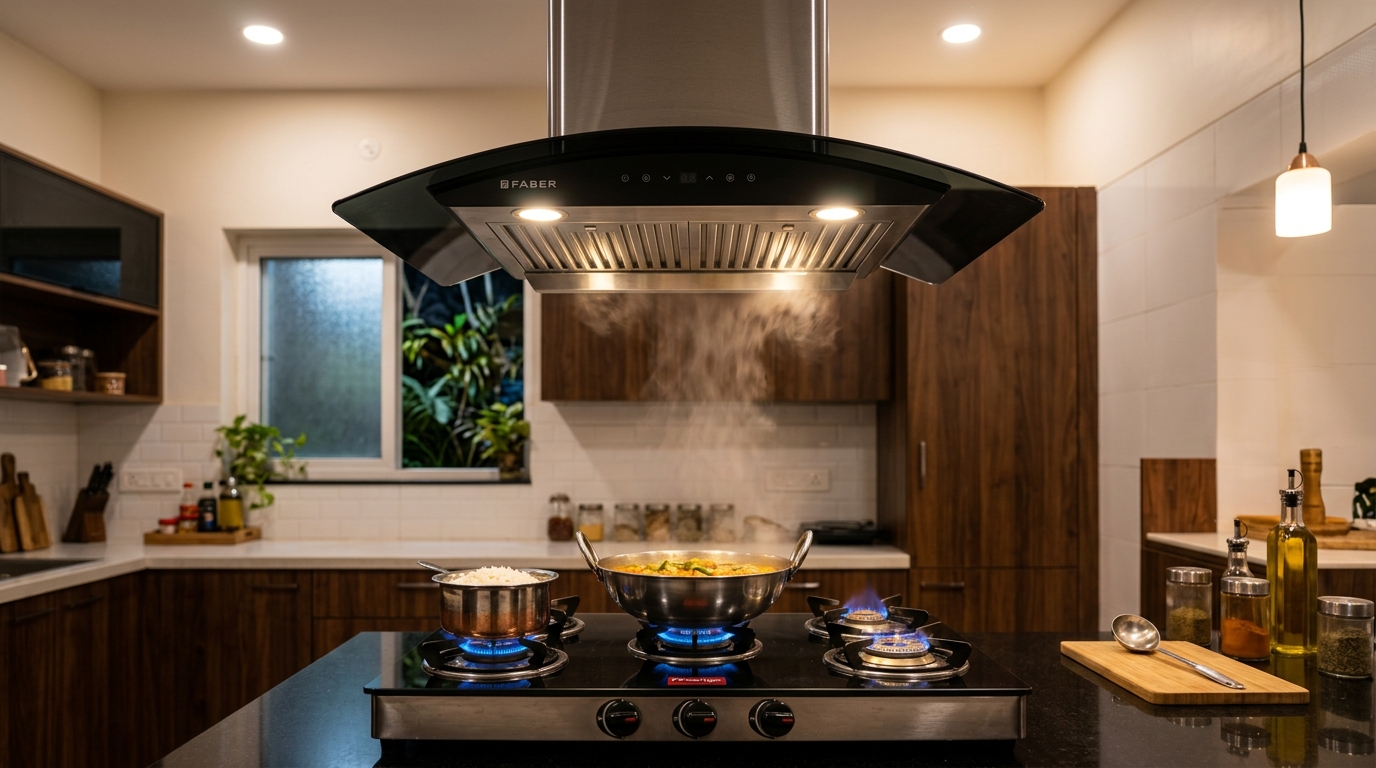
Indian culinary traditions—sizzling ghee tadkas, mustard oil tempering, deep-fried puris, and aromatic masala roasts—generate intense aerosolized grease, pungent spices, and heavy fumes that stain kitchen tiles and yellow ceiling paint within months.
Our authoritative Kitchen Chimney Buying Guide decodes the critical engineering specs for Indian kitchens: Filterless Thermal Auto-Clean vs Stainless Steel Baffle Filters, optimal suction capacity (1200 to 1500+ m³/hr), ducted vs ductless venting, energy-efficient BLDC motors, and intuitive wave gesture controls.
Contents at a Glance
1. Filter Architecture: Filterless vs Baffle vs Mesh
The filter design determines how efficiently grease is trapped and how much manual scrubbing your kitchen will demand:
Filterless with Thermal Auto-Clean
Features no traditional physical filter plates at the intake suction mouth. Instead, high-speed centrifugal airflow directs greasy vapours directly into an internal sealed motor housing. An integrated electric heating element wraps around the motor chamber. With the press of a button, heat melts accumulated sticky oil deposits, which flow down smoothly into a detachable stainless steel or transparent oil collector tray.
Verdict: Ideal for modern busy households who want virtually zero messy scrubbing. Simply empty the oil collector cup once every 3 to 4 weeks.
Stainless Steel Baffle Filters
Engineered with multiple curved stainless steel baffles that force smoke and oily vapours to change direction rapidly (the "Cut-and-Slash" principle). Heavy oil and grease droplets condense on the cool steel surfaces and drain down into internal troughs, while lightweight smoke passes unimpeded through to the exhaust duct.
Verdict: Highly durable and withstands decades of rigorous Indian frying. Requires manual cleaning with warm caustic water or dishwashing liquid once every 3 to 4 weeks.
Cassette / Aluminum Mesh Filters
Constructed of overlapping layers of fine aluminum mesh. While common in Western kitchens for boiling pasta, fine mesh quickly gets suffocated by Indian turmeric, mustard oil, and chilli tempering. Within weeks, pores clog entirely, drastically dropping suction capacity and posing a fire risk if not boiled in caustic soda every 10 days.
Verdict: Not recommended for authentic Indian kitchens.
2. Suction Power (m³/hr): Sizing for Your Cooking Style
Suction capacity is measured in cubic meters per hour (m³/hr)—the volume of air the chimney can evacuate from the kitchen in 60 minutes:
| Suction Capacity | Recommended Cooking Style | Kitchen Size |
|---|---|---|
| 1,000 – 1,150 m³/hr | Light to moderate cooking (boiling, steaming, quick sauteing, low oil curries) | Small enclosed kitchens (<100 sq.ft.) |
| 1,200 – 1,350 m³/hr | Standard Indian cooking (daily tadka, shallow frying, rotis, parathas, sambar) | Medium kitchens (100–180 sq.ft.) with standard 8–10 ft duct length |
| 1,400 – 1,600+ m³/hr | Heavy Indian cooking (deep frying puris/pakoras, non-veg gravies, multi-burner hobs) | Large or Open-concept modular kitchens (>180 sq.ft.) or long duct pipes (>10 ft) |
The Duct Loss Rule of Thumb
Every 90-degree elbow bend in your exhaust duct pipe reduces effective suction by approximately 10% to 15%, and each additional 3 feet of pipe length introduces friction resistance. If your kitchen exhaust outlet is located far from the stove or requires two right-angle bends, always choose a chimney rated for at least 1350 to 1500 m³/hr to compensate for air flow loss.
3. Ducted vs Ductless (Recirculating) Installation
A chimney's exhaust method fundamentally dictates whether heat and humidity leave your home:
Ducted Chimney (Highly Recommended)
Expels all smoke, hot air, aerosolized grease, and pungent spice aromas outside the home through a 6-inch rigid pipe routed through an exterior wall or balcony core-cut.
- 100% heat and moisture extraction (keeps kitchen cool).
- Maximum suction performance and quietest airflow.
- Zero recurring filter replacement expenses.
Ductless / Recirculating Chimney
Passes oily air through physical baffles and an active carbon charcoal filter to neutralize odors, before blowing the air right back into your kitchen.
- Does not expel heat or humidity—kitchen stays hot and stuffy.
- Charcoal filters cannot be washed and must be replaced every 3 to 4 months (recurring cost: ₹1,200 – ₹2,500/year).
- Only use as a last resort in high-rise rental flats where core-cutting exterior walls is strictly forbidden by housing societies.
4. Sizing: 60 cm vs 90 cm Chimneys
Chimney width must correspond to your gas cooktop or built-in induction hob width to catch rising plumes of smoke without spillover:
- 60 cm Chimneys: Designed for standard 2 to 3 burner gas stoves (under 60 cm width). Fits perfectly into compact modular kitchen wall cabinets without monopolizing overhead storage space.
- 90 cm Chimneys: Designed for 3, 4, or 5 burner cooktops and wide built-in kitchen hobs. The extra 30 cm catchment canopy ensures smoke from outer burners is fully captured before it drifts into living and dining areas.
5. BLDC Inverter Motors & Thermal Auto-Clean
Technological upgrades over the past three years have dramatically improved chimney durability and acoustics:
Brushless DC (BLDC) Inverter Motors
Traditional induction motors generate significant heat, consume 180W–250W of power, and emit loud whining noise at high speeds (65–70 dB). BLDC inverter motors use permanent magnets and electronic commutation to cut electricity consumption by up to 50% (operating at just 70W–100W), provide 9-speed precision control, and operate at a whisper-quiet 45 to 52 dB.
Thermal Auto-Clean Technology
Eliminates the dreaded task of scraping greasy gunk from motor impellers. At the push of a dedicated "Auto-Clean" button, high-efficiency heating coils warm the motor housing to approximately 80°C for 10–15 minutes, liquifying viscous oil deposits so they collect neatly in a dishwasher-safe metal oil collector cup.
6. Gesture Control, Touch Panels & Design Profiles
- Wave Motion Gesture Control: Indian home cooks frequently have wet, flour-covered, or oil-slicked hands. Smart gesture sensors allow you to turn on the chimney and cycle through speed settings with a simple wave of your hand across the infrared sensor—keeping the tempered black glass panel spotless.
- Curved Glass vs Box vs Inclined/T-Shape:
- Curved Glass Wall-Mounted: The most popular contemporary look in Indian modular kitchens; balances aesthetic charm with a wide suction catchment basin.
- Inclined / Angular Chimneys: Mount flush at a 45-degree angle against the wall. Provides 100% head clearance so tall cooks never bump their forehead against the canopy edge.
- Pyramid / Straight Line: Heavy-duty stainless steel industrial aesthetic, ideal for traditional closed kitchen layouts.
- Dual LED Spotlights: Look for chimneys equipped with dual 1.5W–3W energy-efficient daylight LED lamps to brightly illuminate your cooking pots and pans without casting shadows.
7. Top Kitchen Chimney Brands in India
- Faber: Italian engineering pioneer with extensive manufacturing presence in Pune. Known for robust 3-way suction technology, high-end BLDC motors, and durable baffle filters.
- Elica: Highly trusted across Indian modular kitchens for striking curved glass designs, filterless auto-clean mechanisms, and silent deep-silence motor technology (EDS).
- Hindware Smart Appliances: Homegrown leader offering excellent value for money in filterless thermal auto-clean chimneys with reliable pan-India after-sales service and gesture sensing.
- Glen: Renowned for high-grade 304 stainless steel construction, 100% copper wound motors, and durable Italian baffle filter assemblies.
- Kaff: Premium European designs, heavy-duty suction blowers, and sleek inclined touch displays.
8. Pre-Installation & Ducting Best Practices
Indian Kitchen Installation Guidelines
- Height Above Gas Stove: Maintain an exact vertical distance of 65 cm to 75 cm (26 to 30 inches) between the gas burner grates and the bottom edge of the chimney. Installing too low risks catching fire from open flames; installing too high (>80 cm) severely degrades suction efficiency.
- Exhaust Pipe Diameter: Always insist on a 6-inch (150 mm) diameter pipe. Never choke the outlet down to a 4-inch pipe with cheap adaptors, as this increases motor backpressure, doubles operating noise, and cuts suction by over 30%.
- Rigid Aluminum vs Corrugated Flexible Pipe: Standard flexible silver accordion pipes flap and rattle loudly under high suction. Upgrade to a rigid aluminum duct or smooth PVC pipe wrapped in noise-damping acoustic tape for whisper-quiet performance.
- Exterior Cowl / Louver: Install an exterior anti-pest cowl with gravity louvers over the outside wall exit hole to prevent pigeons, squirrels, lizards, and rainwater from entering the exhaust pipe.
9. Frequently Asked Questions
Q1. Is a filterless chimney really effective for heavy Indian cooking?
Yes. Filterless chimneys are exceptionally effective because there are no physical mesh screens to get clogged with turmeric and grease over time. High-speed centrifugal force flings oily droplets directly into the non-stick motor housing, which are then liquified by thermal auto-clean coils and channeled into the external oil collector cup. Suction power remains consistently high day after day.
Q2. How often do I need to run the Thermal Auto-Clean function?
For standard Indian cooking with daily frying and tadka, activate the auto-clean cycle once every 15 to 20 days. Simply press the auto-clean button after cooking; the heating element will run for roughly 10 minutes and automatically shut off. Empty and wash the oil collector cup with warm water and liquid dish soap once a month.
Q3. What is the standard cost of installing a chimney and cutting the wall hole?
Core cutting a 6-inch circular hole through an external brick or RCC wall typically costs between ₹800 and ₹1,500. Standard brand installation charges range from ₹500 to ₹800. If you purchase an upgraded aluminum exhaust duct kit with an exterior cowl, expect an additional ₹1,000 to ₹1,500.
Q4. Can I convert a ducted chimney into a ductless chimney later?
Most ducted chimneys from brands like Faber, Elica, and Glen support ductless operation if you install optional activated carbon charcoal filter pads over the motor inlet. However, suction performance will drop by roughly 25%–30%, the kitchen will remain humid, and charcoal filters must be replaced every 3 to 4 months.
Q5. Why is my chimney making so much noise?
Excessive chimney noise is almost always caused by poor ducting rather than the chimney motor itself. Common causes include: using an undersized 4-inch pipe instead of 6 inches, having more than two 90-degree pipe bends, a loose unanchored flexible foil pipe that vibrates against cabinets, or an uncleaned oil collector cup causing motor imbalance.